


- Retail chatbot spending is projected to grow from $12 billion in 2023 to $72 billion by 2028 — driven by real returns on cost reduction and conversion.
- Start with one use case: order tracking, cart recovery, or product recommendations.
- Track containment rate, conversion rate, and cart recovery rate — and keep refining after launch.
It's happened to all of us — standing in a store, needing quick information or a different shoe size, while every sales associate is busy. So you wait.
Today, retail chatbots are solving that same problem online — instantly.
A retail chatbot is an AI-powered assistant that helps shoppers find answers, products, and recommendations in real time, directly on a store's website or social channels. And the numbers show they're becoming essential: retail spending on chatbots is expected to soar from $12 billion in 2023 to $72 billion by 2028.
Shoppers are responding too: 69% of consumers have already used AI for online shopping, and shopping-related AI use grew 35% between February and November 2025.
In this guide, we'll explore how retail chatbots are reshaping digital shopping — and why more brands are turning to them to recover lost sales and improve the customer experience.
Cosa sono i chatbot per il retail?
A retail chatbot is an AI-powered assistant built for online shopping — using natural language processing (NLP) and conversational AI to understand customer questions and respond in real time, from product discovery to post-purchase support.
Today's retail chatbots go far beyond simple rule-based bots. Built on large language models (LLMs), they can handle complex queries, personalize recommendations, and engage shoppers across websites, social channels, and messaging apps.
Come funzionano i chatbot per il retail?
I chatbot per il retail utilizzano la tecnologia AI per automatizzare le fasi chiave del percorso d’acquisto.
Integrandosi con sistemi di inventario e piattaforme di pagamento, offrono supporto in tempo reale e assistenza personalizzata per migliorare l’esperienza cliente e aumentare le vendite.
Ecco una spiegazione passo dopo passo:
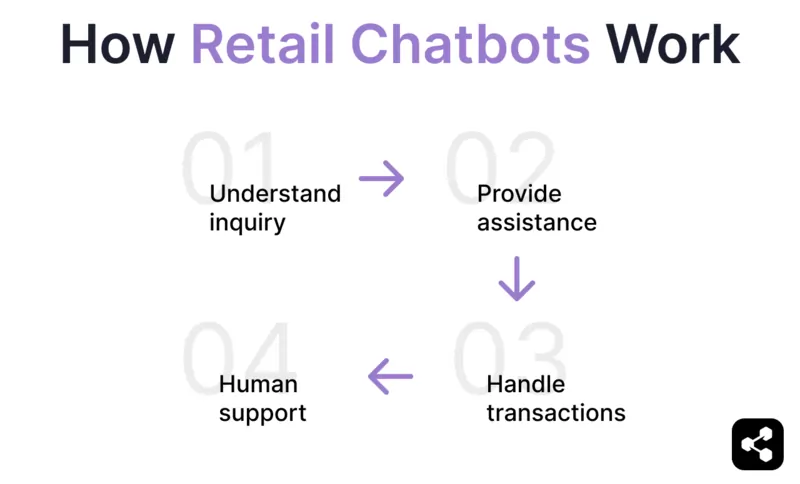
1. Comprendere le richieste dei clienti
Quando un cliente interagisce con un chatbot retail, non si limita a riconoscere le parole. Vengono analizzate tramite NLP per determinare cosa desidera il cliente (intento) e i dettagli rilevanti (contesto).
Ad esempio, se un cliente chiede: ‘Avete queste sneakers nel numero 9?’. Il chatbot identifica:
- Intento: il cliente cerca la disponibilità di un prodotto.
- Contesto: il prodotto specifico (sneakers) e la taglia richiesta (9).
2. Fornire assistenza personalizzata
Una volta che il chatbot determina l’intento dell’acquirente (trovare un prodotto specifico) e analizza il contesto (taglia e stile richiesti), controlla l’inventario e risponde con la disponibilità in tempo reale.
Se le sneakers sono disponibili, potrebbe rispondere: ‘Sì! Sono disponibili. Le preferisci nere o bianche?’
Se la taglia non è disponibile, il chatbot può:
- Consiglia stili simili
- Avvisa il cliente quando l’articolo torna disponibile
- Offri la possibilità di unirsi a una lista d’attesa
3. Gestire transazioni e ordini
Quando un cliente decide di acquistare, il chatbot gestisce il processo di acquisto interagendo con i principali sistemi retail:
- Sistema di gestione ordini (OMS): verifica l’inventario e genera l’ordine.
- Gateway di pagamento (Stripe, PayPal, ecc.): elabora le transazioni e applica eventuali sconti.
- Sistemi di spedizione e consegna: raccoglie i dettagli di spedizione e fornisce stime di consegna in tempo reale.
Il chatbot Rufus di Amazon consente ai clienti di acquistare prodotti monitorando prezzi e inventario in tempo reale tramite il sistema commerciale di Amazon. Completa il checkout utilizzando i dati salvati del cliente, fornendo conferma e tracciamento immediati.
4. Escalation al supporto umano
Quando una richiesta è troppo complessa per il chatbot, viene attivato un processo di escalation con intervento umano per garantire una transizione fluida.
Il chatbot rileva quando una domanda supera le sue capacità, come l’approvazione di sconti speciali o la gestione di reclami per frode.
L’escalation viene attivata in base a punteggi di confidenza, regole aziendali predefinite o richieste esplicite del cliente.
Prima del trasferimento, il chatbot raccoglie i dettagli chiave per l'agente, tra cui:
- Un riepilogo della richiesta del cliente e delle interazioni precedenti.
- Eventuali soluzioni tentate o policy rilevanti.
Il sistema quindi instrada la conversazione all’agente più qualificato e la trasferisce all’interno della stessa interfaccia di chat.
Una volta che l’agente risolve il problema, il chatbot rientra nella conversazione per:
- Conferma la risoluzione e offri ulteriore supporto.
- Impara dall’interazione per migliorare le risposte future.
Cosa possono fare i chatbot per il retail?
Modern retail chatbots can handle far more than simple customer queries — they plug into your existing systems, engage shoppers at every stage of the buying journey, and automate workflows that would otherwise require a human touch.
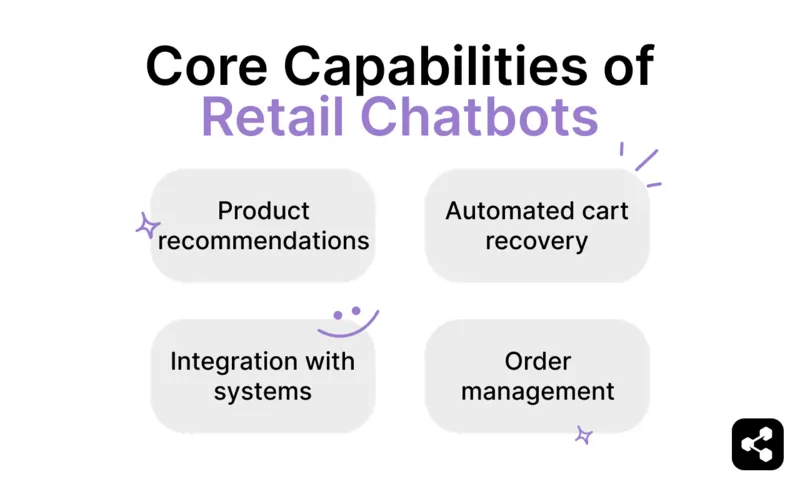
Consiglia prodotti
Retail chatbots use browsing history, past purchases, and real-time behavior to deliver personalized product suggestions and upsell opportunities at the right moment — not just post-purchase, but during the discovery phase too.
Forrester prevede che gli assistenti AI diventeranno indispensabili per la ricerca di prodotti, il confronto e l’acquisto guidato su tutte le piattaforme di retail.
Ad esempio, se un cliente sta cercando scarpe da corsa, il chatbot potrebbe suggerire calzini sportivi abbinati o una promozione a tempo limitato.
Automate cart recovery
70% of online shopping carts are abandoned globally — but $260 billion worth of those lost orders are recoverable through better checkout experience alone.
If a customer adds items to their cart but doesn't complete the purchase, a retail chatbot can send timely reminders, answer last-minute concerns, and offer incentives to nudge them toward checkout.
Integrate with internal systems
Retail chatbots connect directly with your CRM, inventory, and pricing systems to keep customer data synchronized and accurate.
When a shopper asks about stock availability or a personalized promotion, the chatbot pulls live data to give a reliable answer — no manual lookup required.
Gestione ordini
If a shopper asks "where is my order?", a retail chatbot can instantly retrieve tracking details and provide an estimated delivery date. If a return is needed, it can initiate the process, generate shipping labels, and walk the customer through each step — all without human intervention.
Casi d'uso dei chatbot per il retail
Retail chatbots are being deployed across every corner of the shopping experience — from the first product search to post-purchase support. Here are some of the most impactful ways retailers are putting them to work.
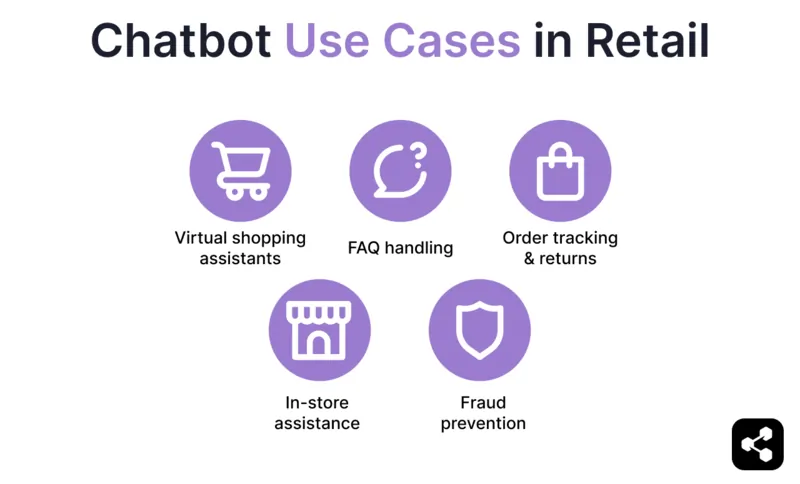
Assistenti virtuali per lo shopping
I chatbot per il retail agiscono come assistenti digitali alle vendite, guidando i clienti verso i prodotti più adatti in base alle loro preferenze e alla cronologia degli acquisti.
Whether a shopper needs style advice or restock alerts, retail chatbots provide real-time, personalized assistance around the clock.
Example: Fromages d’ici uses Froméo, an AI-powered virtual shopping assistant, to help customers navigate a catalog of over 1,000 cheeses through personalized, conversational recommendations.
Gestione delle FAQ
gestisci le richieste comuni dei clienti, incluse le politiche del negozio e le procedure di reso, senza coinvolgere il personale.
Retail chatbots act as FAQ chatbots, handling high volume, repetitive customer inquiries that would otherwise tie up support staff — store policies, sizing questions, return processes, and more — instantly and at any hour.
Tracciamento ordini e resi
"Where is my order?" is one of the most common questions in retail. Chatbots integrate with order management systems to provide real-time tracking updates, initiate returns, generate shipping labels, and walk customers through each step — no human required.
Assistenza in negozio
Some retailers extend their chatbot beyond the website, using kiosks or mobile apps in-store to help customers check inventory, locate products, and compare specs — bridging the gap between physical and digital shopping.
Prevenzione delle frodi
By integrating with payment gateways and fraud detection tools, retail chatbots verify transactions and guide customers through secure payment processes in real time — reducing the risk of unauthorized purchases without adding friction to the checkout experience.
Vantaggi dei chatbot per il retail
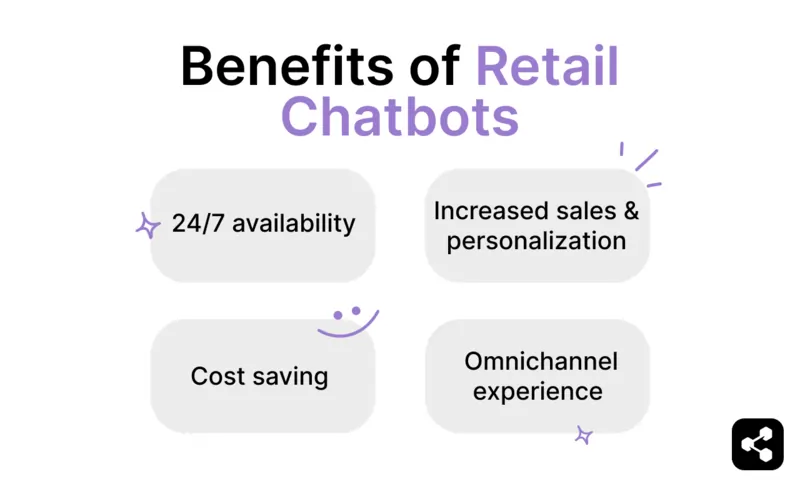
Provide 24/7 support
Shoppers don't keep business hours — and neither do chatbots. Unlike human agents, retail chatbots provide round-the-clock assistance, eliminating long wait times and ensuring customers get answers the moment they need them.
That availability directly impacts the bottom line. 72% of customers expect immediate service, and 64% spend more when their issues are resolved in-chat — making 24/7 responsiveness less of a perk and more of a revenue driver.
Increase sales and personalization
Retail chatbots analyze customer preferences and past purchases to recommend relevant products in the moment — turning passive browsers into active buyers.
Fromages d'ici saw this firsthand: 20% of users explored more site content after chatting with Froméo, showing how conversational commerce naturally drives deeper product discovery.
Reduce cost
As margins tighten, cost reduction has become one of the strongest arguments for AI adoption in retail.
Chatbots handle the repetitive, high-volume inquiries — order tracking, product availability, return policies — that eat up agent time, automating them at scale without sacrificing response quality.
According to Forrester, retailers entering 2026 face a landscape where investment in customer-facing automation is no longer optional.
Improve omnichannel experience
Retail chatbots integrate across websites, mobile apps, and messaging platforms like WhatsApp chatbots and Facebook Messenger chatbots — meeting customers wherever they already are.
Backend synchronization means real-time data travels with the customer across every channel, so context is never lost when they switch between touchpoints.
Come creare un chatbot per il retail
Building a chatbot starts with a clear use case, not a tool. The strongest implementations focus on a specific outcome — answering product questions, recovering carts, or guiding purchases — and expand from there.
From there, it’s about connecting the right data (like product catalogs or order systems), designing how the chatbot interacts with users, and choosing a platform that can support both simple flows and more advanced automation as needs grow.
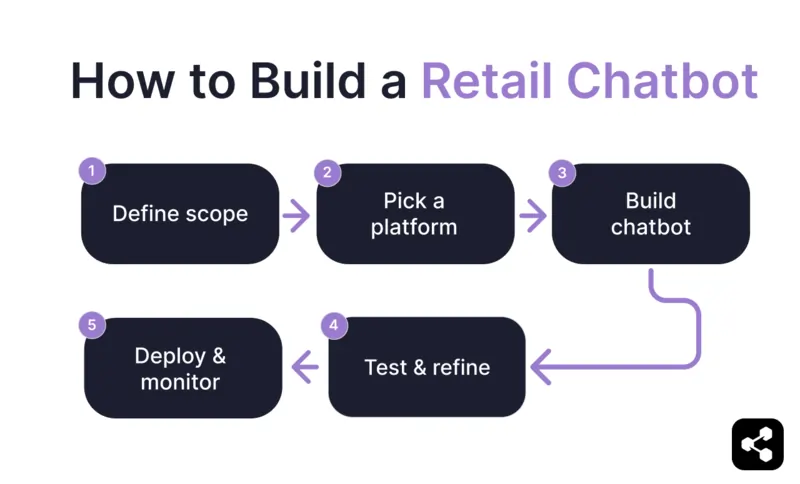
1. Definisci il tuo ambito
Most retail chatbots fail because they try to do everything at once — product discovery, order support, retention, upselling — before any of it works well. Start with one high-impact use case instead.
Pick something concrete: order tracking, product recommendations, or FAQ deflection. Then define three things before you build:
- The primary user intent you're serving
- The metric that defines success (conversion rate, deflection volume, CSAT)
- What the bot explicitly won't handle yet
That last one matters as much as the first two. A clear scope gives you something you can ship, measure, and improve — before you expand.
2. Choose the right platform
The platform decision shapes everything downstream, so evaluate early. Look for native NLP, real-time data retrieval, and integration support for your existing stack — not just a slick demo.
If you're comparing options, our list of the top AI platforms is a good starting point.
Pro tip: For retail specifically, flexibility matters. You'll want a platform that can handle both structured flows (guided product finders, checkout support) and more open-ended conversations without requiring a full rebuild when your scope expands. Botpress's Autonomous Nodes, for example, let agents dynamically switch between the two — it's especially necessary as your bot matures beyond its initial use case.
3. Build and integrate
Connect your chatbot to your retail stack from day one — e-commerce platform (Shopify, Magento, WooCommerce, etc.), order management system, and CRM. Without these integrations, the bot can't deliver accurate pricing, real-time inventory, or reliable order tracking, which are the basics customers expect.
On the conversation design side, train on real data. Use past support tickets, chat logs, and search queries rather than assumptions about how customers talk. Adapt for regional phrasing and multiple languages if your customer base warrants it.
Build in proactive touches too — abandoned cart reminders, back-in-stock alerts, browse-based recommendations. These drive revenue without requiring any customer initiation.
4. Plan for human handoff
Not every conversation should be automated. Complex returns, payment disputes, and frustrated customers all benefit from smooth escalation to a human agent — with full context preserved so the customer never has to repeat themselves.
Define those escalation triggers early; retrofitting them later is painful.
5. Launch, monitor, and improve
Once live, treat the chatbot as a product, not a project. Track engagement rates, resolution rates, and conversion impact on an ongoing basis.
Real-world interactions will surface gaps that testing never does — the bots that perform best are the ones that get refined consistently after launch.
9 metriche per valutare i chatbot per il retail
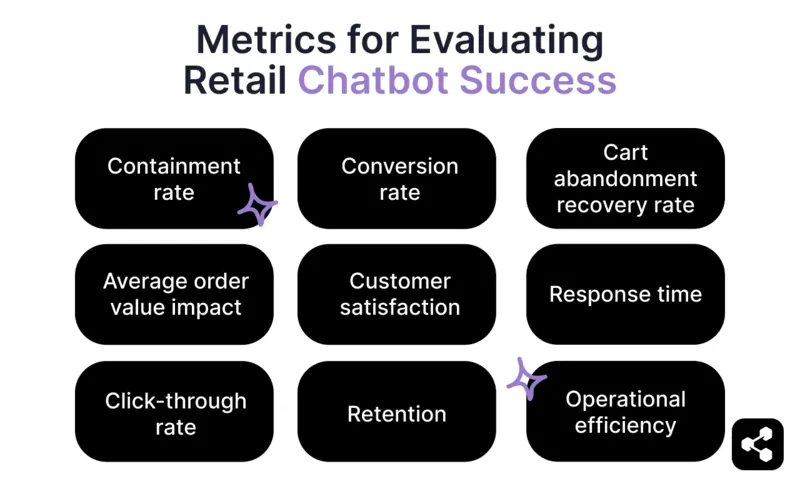
1. Containment rate
Containment rate is the percentage of chatbot conversations that are fully resolved without being handed off to a human agent.
Formula
Containment rate = (Number of conversations resolved by chatbot ÷ Total conversations) × 100
Esempio
If a chatbot handles 10,000 conversations in a month and 9,500 are resolved without escalation, the containment rate is: (9,500 ÷ 10,000) × 100 = 95%
2. Conversion rate
Conversion rate is the percentage of chatbot interactions that result in a desired action, such as a purchase, signup, or adding a product to cart.
Formula
Conversion rate = (Number of conversions ÷ Total chatbot sessions) × 100
Esempio
If a chatbot drives 2,000 sessions in a month and 300 result in a purchase or signup, the conversion rate is: (300 ÷ 2,000) × 100 = 15%
3. Cart abandonment recovery rate
Cart abandonment recovery rate is the percentage of abandoned carts that are successfully recovered through chatbot interaction.
Formula
Cart abandonment recovery rate = (Recovered carts ÷ Total abandoned carts engaged by chatbot) × 100
Example
If 500 users abandon their carts and the chatbot re-engages them, and 125 complete their purchase, the recovery rate is: (125 ÷ 500) × 100 = 25%
4. Average order value (AOV) impact
Average order value (AOV) measures the average amount spent per order, and can be used to compare chatbot-influenced purchases vs. overall purchases.
Formula
AOV = Total revenue ÷ Total number of orders
Example
If chatbot users generate $50,000 in revenue across 1,000 orders, the AOV is: $50,000 ÷ 1,000 = $50
5. Customer satisfaction (CSAT)
Customer satisfaction (CSAT) is the average score customers give to their chatbot experience, typically collected through post-interaction surveys.
Formula
CSAT = (Number of positive responses ÷ Total responses) × 100
Example
If 200 users respond to a survey and 160 rate the experience positively, the CSAT score is: (160 ÷ 200) × 100 = 80%
6. Response time
Response time is the average time it takes for the chatbot to reply to a user message.
Formula
Average response time = Total response time ÷ Number of responses
Esempio
If a chatbot takes a total of 5,000 seconds to respond across 1,000 messages, the average response time is: 5,000 ÷ 1,000 = 5 seconds
7. Retention
Retention rate is the percentage of users who return to interact with the chatbot after their first session.
Formula
Retention rate = (Returning users ÷ Total users) × 100
Esempio
If 1,000 users interact with the chatbot and 300 return for another session, the retention rate is: (300 ÷ 1,000) × 100 = 30%
8. Click-through rate (CTR)
Click-through rate (CTR) is the percentage of users who click on chatbot suggestions such as product links, offers, or recommendations.
Formula
CTR = (Number of clicks ÷ Number of impressions) × 100
Esempio
If a chatbot shows 2,000 product recommendations and users click on 400 of them, the CTR is: (400 ÷ 2,000) × 100 = 20%
9. Operational efficiency
Operational efficiency measures how much the chatbot reduces support workload and cost by automating conversations.
Formula
Cost per conversation = Total support cost ÷ Total conversations
Esempio
If human support costs $10,000 for 5,000 conversations ($2 per conversation), and the chatbot handles 3,000 of those at near-zero cost, the effective cost per conversation decreases significantly as automation increases.
Distribuisci un chatbot personalizzato per il retail
Botpress è una piattaforma chatbot altamente flessibile, di livello enterprise, progettata per il retail. La nostra tecnologia consente alle aziende di creare chatbot personalizzati che migliorano le interazioni con i clienti e aumentano le vendite.
Con un’integrazione fluida tra piattaforme e-commerce, CRM e app di messaggistica, il tuo chatbot può coinvolgere i clienti ovunque facciano acquisti.
La nostra suite di sicurezza avanzata garantisce che i dati dei clienti siano sempre protetti e completamente sotto il controllo del tuo team.
Domande frequenti
How do retail chatbots help reduce cart abandonment?
Retail chatbots recover abandoned carts by sending timely reminders, answering customer concerns, and offering incentives to encourage checkout, helping retailers reclaim a portion of the 70% of online shopping carts that are typically abandoned.
Can retail chatbots work 24/7?
Yes, retail chatbots provide round-the-clock assistance, ensuring shoppers get instant answers anytime without wait times, which improves customer satisfaction and increases revenue potential.
What tasks can a retail chatbot handle?
Retail chatbots can handle product recommendations, FAQ responses, order tracking, returns processing, cart recovery, and even fraud prevention by integrating with inventory systems, payment gateways, and order management platforms.
Do retail chatbots replace human customer support teams?
No, retail chatbots are designed to handle repetitive, high-volume inquiries and augment human teams rather than replace them. They escalate complex issues to human agents while preserving conversation context for a seamless handoff.
How much does it cost to build a retail chatbot?
Simple FAQ or order-tracking chatbots can be built for free or a few hundred dollars using low-code platforms, while advanced retail chatbots with extensive integrations may require higher ongoing costs depending on scope and customization.
Can I build a retail chatbot without technical skills?
Yes, you can build a retail chatbot without a developer or technical background by using no-code or low-code platforms like Botpress, which offer intuitive interfaces, templates, and drag-and-drop tools to create conversational flows.
How do I measure if my retail chatbot is successful?
Key metrics include containment rate (percentage of inquiries resolved without human help), conversion rate, cart abandonment recovery rate, customer satisfaction scores, response time, and operational efficiency in reducing support costs.