.webp)



- 88% of organizations use AI in digital transformation, but only 6% capture meaningful returns.
- High performers invest 70% in training, workflow redesign, change management.
- ROI timelines vary: 3-6 months for automation, 2-3+ years for transformation.
Most companies approach AI transformation from the wrong starting point.
88% of organizations have adopted artificial intelligence in digital transformation. But only 6% are capturing meaningful returns.
The problem isn't the technology. The algorithms in enterprise chatbots work fine. It's an execution gap—specifically, how companies think about what they're building.
High-performing business leaders share a surprising insight: they invest 70% of AI Transformation resources in people and processes (not algorithms).
They redesign workflows instead of automating tasks. And they treat AI as a strategic capability not a cost-reduction tool.
Artificial intelligence and digital transformation represent roughly $1 trillion in market value by 2030. Meanwhile organizations waste an estimated $2.3 trillion globally on failed digital transformation efforts.
You must know why most AI changes stop to avoid being in the 94% that fails. Understand this before you start building anything.
Why Most Digital Transformation Efforts Fail
Companies Treats AI Like Software, Not Strategy
Most organizations treat AI like an IT project.
They buy tools, run pilots, wonder why nothing scales. The 6% who succeed with AI adoption treat it like a business redesign.
High performers are 3x more likely to redesign workflows rather than automate existing ones. They start with the outcome they want and rebuild the process around it — rather than asking how AI can speed up individual tasks.
The distinction is key: automation assumes the current workflow is sound. Redesign assumes it isn’t.
That’s also why leading organizations are further along with AI agents. Agents don’t just respond to prompts; they take action across systems. But agents only work when workflows are rebuilt to support them. Without redesign, agents become fragile experiments. With it, they become part of how the business operates.
Frictionless Pilots Never Reach To Production
MIT research reveals that only 5% of custom GenAI tools make it from pilot to production—a failure rate that highlights the gap between "impressive demo" and "runs our business operations."
Most organizations approach AI pilots like test drives: smooth, controlled environments designed to showcase potential. But production deployment isn't a test track.
According to Forbes contributor Jason Snyder, demos "without governance, memory and workflow redesign, they deliver no value."
The pilots that succeed are the ones that deliberately engineer friction into the process: compliance checkpoints that force security reviews, memory systems that require data architecture decisions, workflow changes that demand buy-in from reluctant teams.
A workout that feels effortless builds nothing. The pilots that transition to production embrace resistance as proof of real transformation, not obstacles to avoid. They design for friction:
- Building governance frameworks before deployment
- Integrating with legacy systems even when it's messy
- Redesigning workflows even when stakeholders resist.
“ In experiences, friction is what creates the memory. GenAI is no different. If it’s too smooth, it fades. If it pushes you, it sticks.”- Rick Kiley, Founder of Soho Experiential
AI Budget Funds Tools Instead of People Training
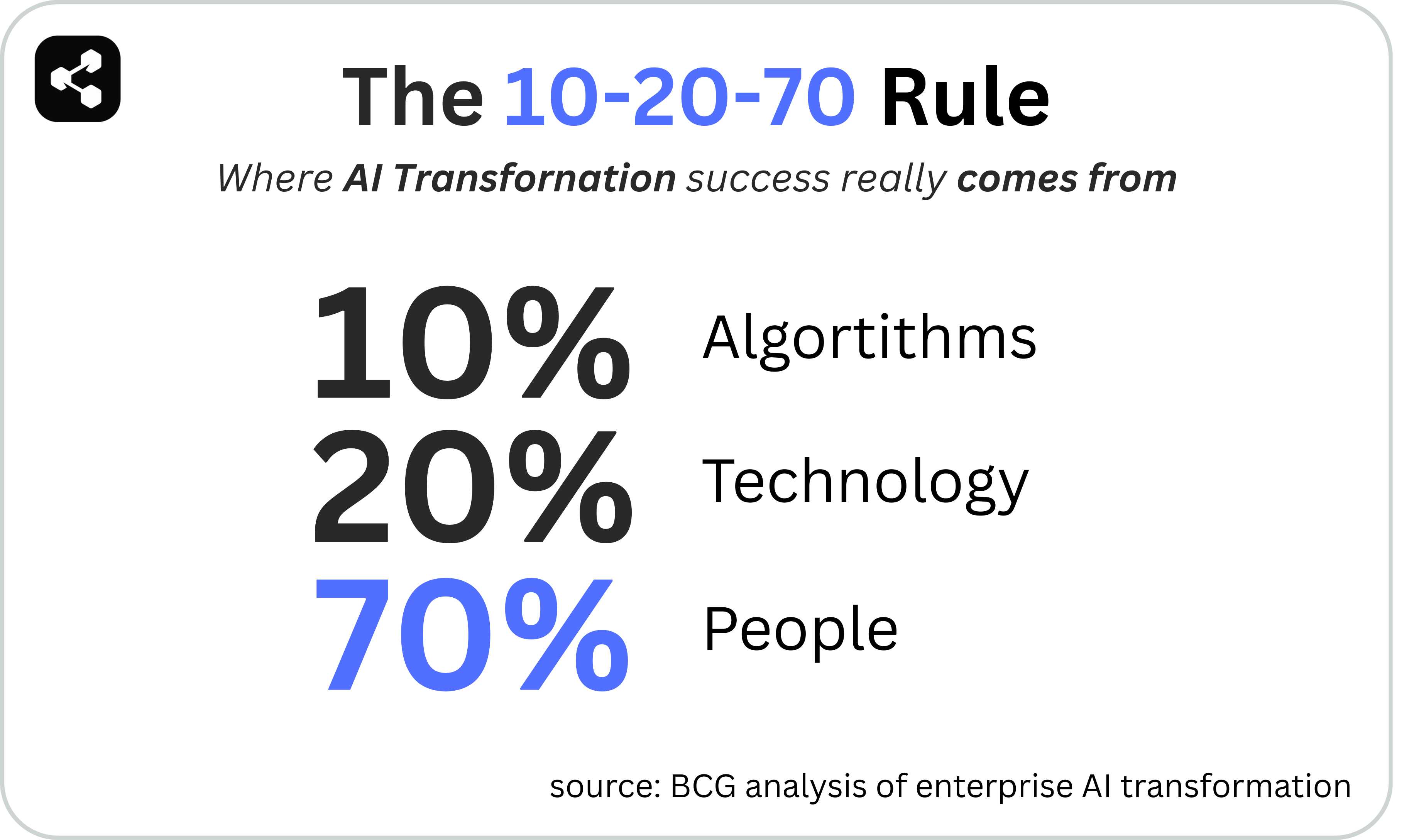
Companies spend their AI budgets in exactly the wrong proportions. BCG research reveals the critical ratio for successful AI transformation:
- 10% on algorithms (the AI models themselves)
- 20% on technology and data (infrastructure and data pipelines)
- 70% on people and processes (training, workflow redesign, change management)
The answer is rather simple: most of the challenges when implementing AI comes from the people. It is a mistake to prioritize technical issues over the human ones.
You can have the best model in the world, but if your team doesn't know how to use it, or your workflows aren't redesigned around it, the technology sits idle.
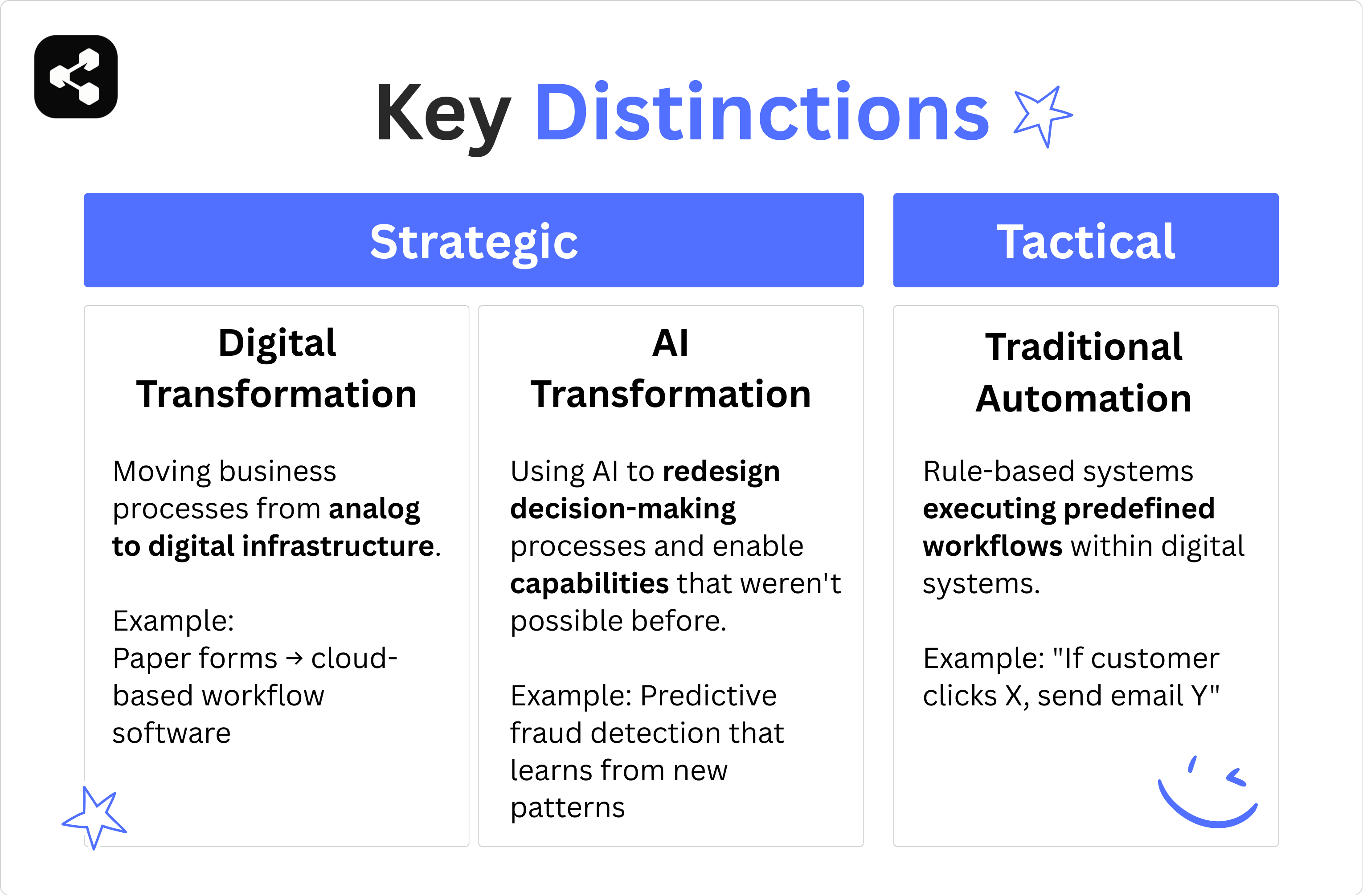
Digital Transformation vs. AI Transformation vs. Automation
Digital transformation moves business processes from analog to digital infrastructure.
→ Compare this to moving from paper forms to cloud-based workflow software.
AI transformation uses AI to redesign decision-making processes and enable capabilities that weren't possible before.
→ Compare this to predictive fraud detection that learns from new patterns.
Traditional automation executes predefined workflows within digital systems — rule-based, repeatable tasks like "if customer clicks X, send email Y."
Here's the clearest way to tell them apart:
- Digital transformation asks: "How do we digitize this process?"
- Traditional automation asks: "How do we remove manual steps from this digital workflow?"
- AI transformation asks: "How should this decision-making process work if we could predict outcomes we couldn't before?"
What AI Can Actually Do for Your Business
Most teams evaluate AI the wrong way. They ask: "Does it have natural language processing? Computer vision? Advanced machine learning?"
Wrong questions.
AI doesn't solve technology problems — it solves business problems. The right questions are: Does it reduce customer churn? Does it speed up decisions? Does it unlock new revenue?
By asking the right question, you can properly implement AI solutions.
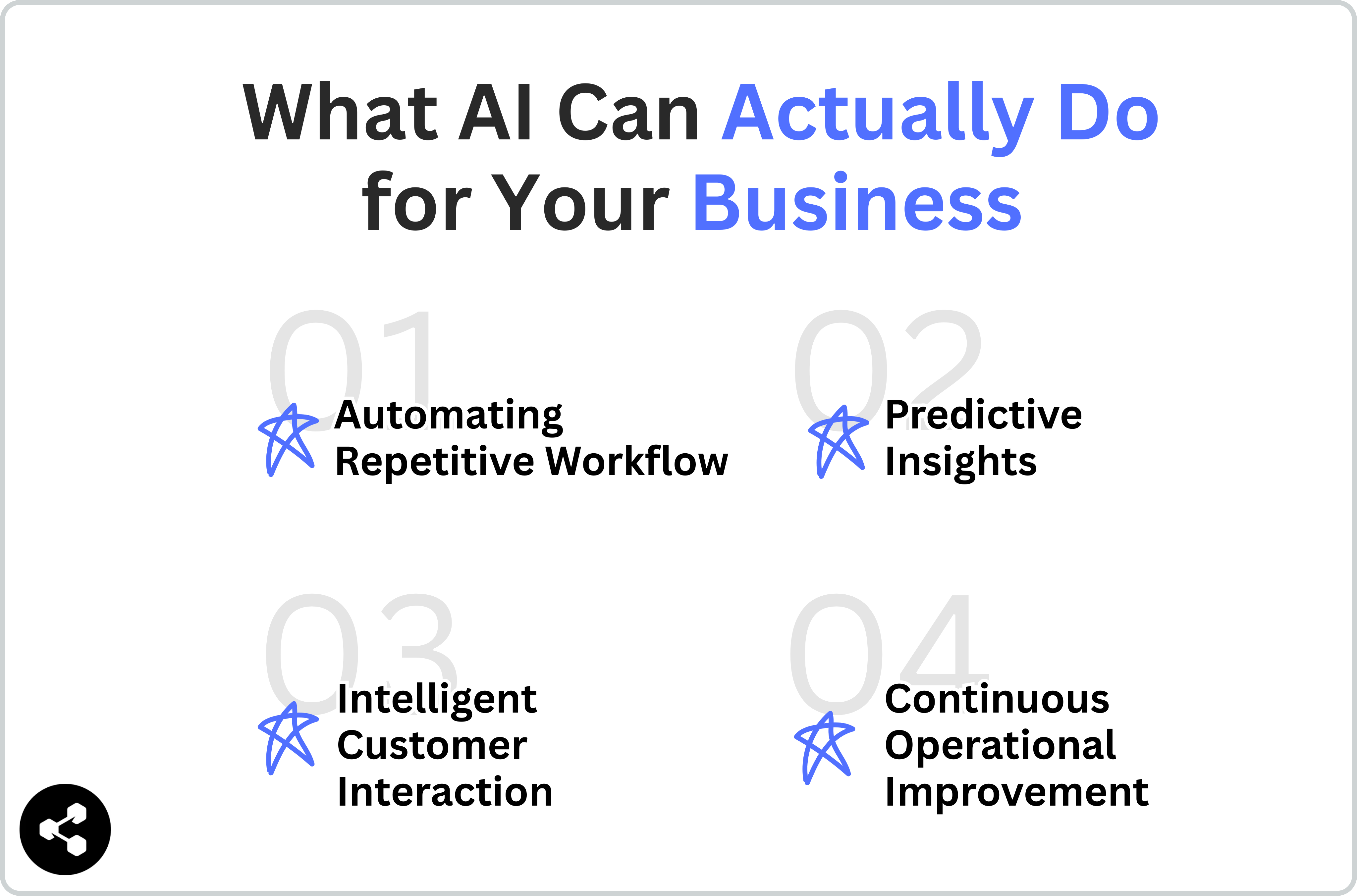
Automating Repetitive Workflow
AI automation scales like software but adapts like humans. When rule-based automation breaks because it encounters an exception, AI handles the exception.
C.H. Robinson proved this at scale: their AI Agent automated 3 million shipping tasks with AI agents, achieving a 40% productivity boost and saving 300 hours daily.
C.H Robinson showed how adaptability is game changing. The AI Agent learns from edge cases instead of breaking when it encounters them.
Predictive Insights
Traditional business intelligence explains what already happened. AI processes massive datasets to predict what's coming next and guide decisions in real time.
The U.S. Treasury’ s fraud detection system demonstrates the gap between reactive and predictive. Using AI-powered detection, they stopped or recovered $4 billion in fraud — compared to $652.7 million the previous year.
The system doesn't flag suspicious activity after the fact; it predicts fraud before it happens.
Intelligent Customer Interaction
Who hasn't waited an hour on hold, wishing the company had digitized customer service?
Bank of America's Erica now handles over 40% of client interactions in some areas, dramatically reducing call center volume and wait times.
But the real improvement is continuity. Customers resolve issues without repeating information to multiple agents, which directly improves satisfaction scores.
Continuous Operational Improvement
While traditionally automated processes remain static, AI systems continuously learn and create compounding advantages.
Amazon's DeepFleet system learns and improves across 1 million robots. Each error becomes a lesson for the entire fleet. The gap between Amazon's logistics costs and those of its competitors grows every quarter. This is not just because they use robots, but because their robots are getting smarter.
The ROI You Can Expect from AI in Digital Transformation
Let's talk numbers — not projections, but actual documented returns.
The range is wide because execution matters more than the technology itself. But patterns emerge when you look at what high performers achieve versus everyone else. Here's what AI delivers across three measurable dimensions: cost reduction, revenue growth, and speed.
Cost Savings You Can Measure
Siemens achieves 50% reduction in unplanned downtime and up to 55% improvement in maintenance efficiency.
UPS saves $300-400 million annually through AI route optimization.
Cost savings happen fast when there is a high volume. AI can manage exceptions in repetitive tasks that traditional automation struggles with.
Revenue Growth You Can Track
McKinsey’s research finds that companies that excel at personalization most often see a 10–15% revenue lift.
Revenue impact takes longer to show than cost savings, but it is often bigger. Personalization at scale was not possible before AI. Now, it is essential.
AI-powered customer interactions are one of the fastest ways to capture this revenue lift — learn how to calculate your chatbot ROI here.
Speed Advantages That Compound
AI compresses timelines in domains with long feedback loops like drug discovery, product development, and diagnostics. The competitive advantage compounds because faster iteration means faster learning.
Insilico Medicine used AI to move a drug from target identification to Phase I in less than 30 months. This is much faster than the usual 3 to 6 years.
When ROI Takes Longer (and why it's still worth it)
Not every AI investment pays back in quarters.
Enterprise-wide transformation typically requires 2-3+ years to show meaningful returns. Why? Redesigning workflows takes time, data infrastructure needs upgrading, governance frameworks must be established, and teams need training.
Again; the hard part isn't the AI but getting humans and processes to work differently.
What this means for you is that competitors can buy the same AI tools. However, they cannot copy the learning and improvements your organization creates. Use quick wins in automation to finance the harder work of workflow redesign and capability building.
How to Build and Execute an AI Transformation
The cart is the AI technology — the models, the platforms, the features. The horse is your business strategy — the outcome you're solving for and the process redesign that makes it possible.
Most transformations put the cart first. They pick tools, then figure out what to do with them. The 6% who succeed do the opposite: they define the outcome, redesign the process, then select the technology that fits.
Here's the end-to-end AI transformation playbook the 6% use — starting with strategic chatbot implementation rather than tool selection.
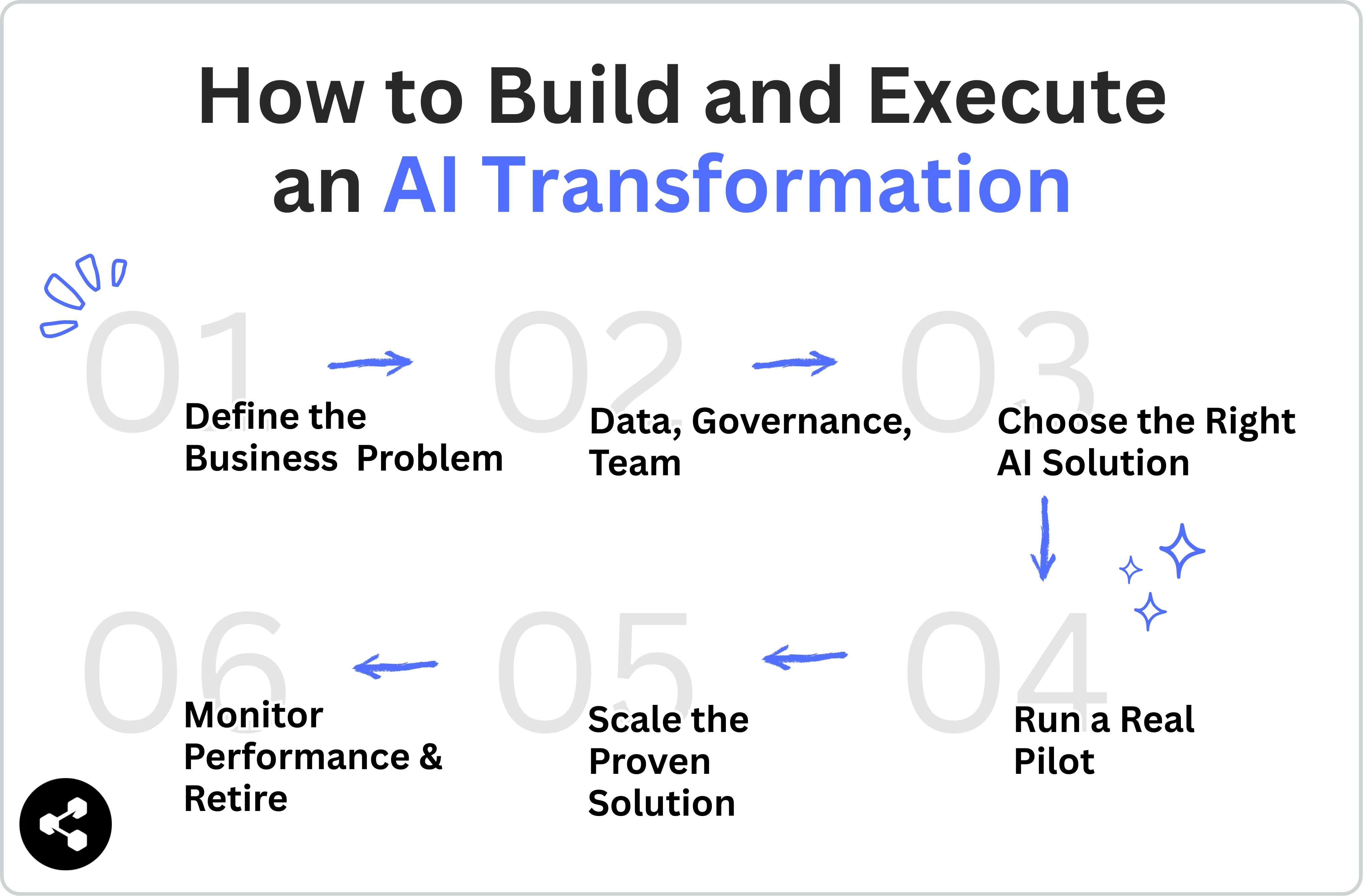
1. Define The Business Problem First
Question your motivation for adopting AI. The business problem should exist whether AI solves it or not. If your answer is "we're doing this to test AI," then you are not ready.
Lead with revenue growth, not cost cutting.
Forbes research shows revenue-focused transformations succeed 63% of the time versus 44% for cost-reduction projects — likely because revenue initiatives get executive attention and cross-functional buy-in that cost projects don't.
Be specific about the outcome. The goal is not only to "improve customer service." But to "reduce resolution time from 11 minutes to under 2 minutes." While maintaining a satisfaction rating of 4 stars or higher.
2. Build Your Foundation: Data, Governance and Team
Data Readiness Comes First
Data readiness does not mean having a lot of data. It means having the right data that is well-managed and easy to access for the right people.
The Virginia ODGA AI Data Readiness Checklist provides a practical framework. Before scaling AI, make sure you passed the checklist:
- Governance: Formal policies with defined ownership, accountability for quality, and clear usage rules.
- Cataloging: Centralized inventory documenting what data exists, where it lives, how it was created (lineage), and who can access it
- Quality monitoring: Continuous validation processes, not one-time cleanups. Data quality degrades — you need systems that catch and correct drift.
- Verify infrastructure: Can your AI models access the data they need in real-time, or does someone need to manually export CSVs?
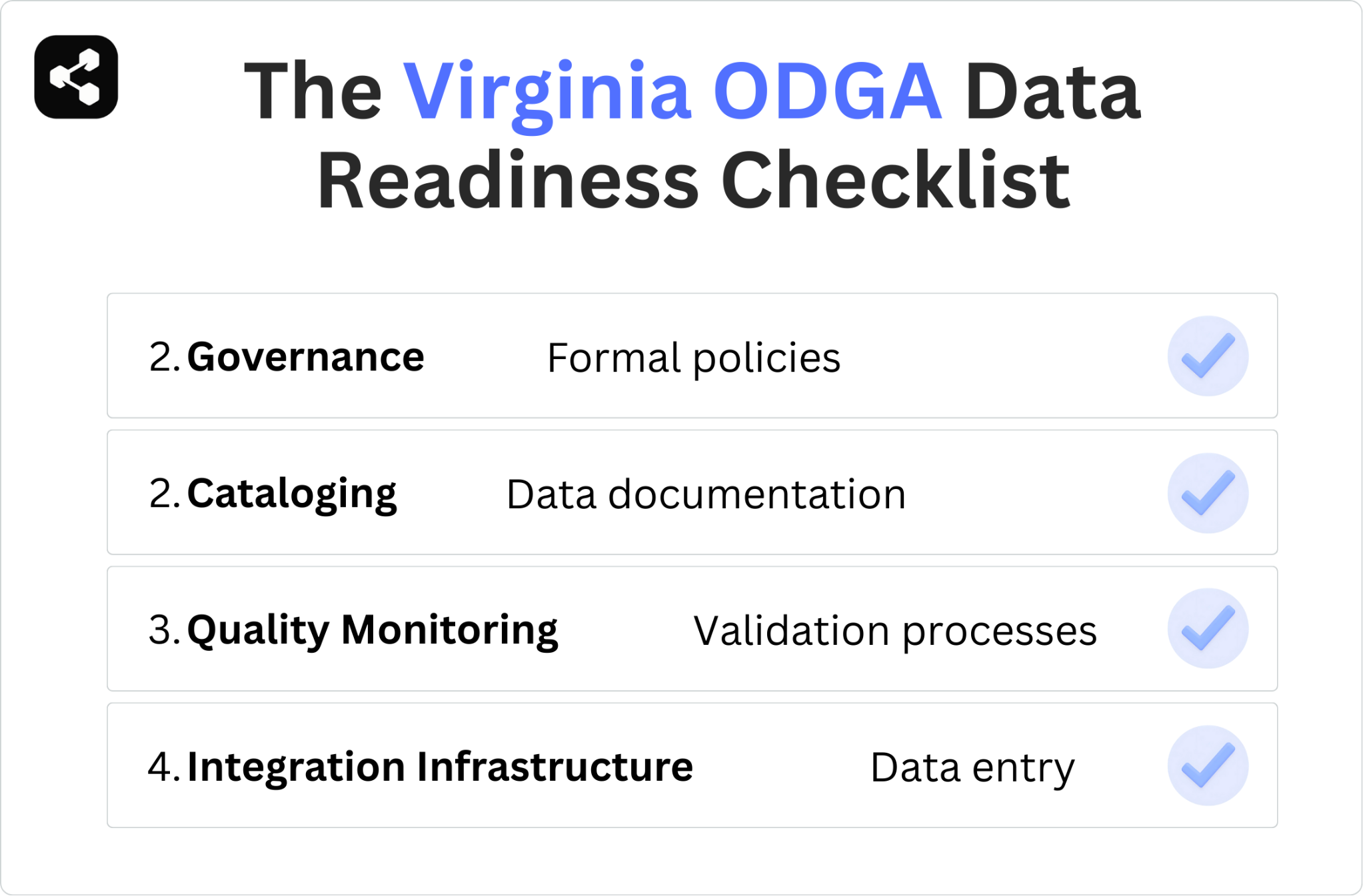
If you can't answer "yes" to all four, you're not ready to scale AI. You might run pilots successfully, but you'll hit a wall at production.
Governance, ethics, and risk control
Governance used to be a compliance burden. Now it's a competitive enabler.
The EU AI Act will fully enforce regulations for high-risk systems by August 2026. Penalties reach €35 million or 7% of global revenue.
Why does governance matter beyond avoiding fines?
Done well, governance enables faster deployment. Teams move quickly when they know the boundaries — what data they can use, which decisions need human oversight, where automated systems can operate autonomously.
What to actually do:
Build governance into your AI strategy from day one:
- Define AI strategy alignment with business goals and risk
- Establish oversight structure with clear roles for AI decisions and accountability
- Set risk boundaries for data use, model deployment, and automated decision-making
- Create performance metrics that track both AI outcomes and ethical compliance
- Build talent capability through training on responsible AI use and governance protocols
Following those steps will accelerate you in the long term, not slow you down.
Assemble The Right Team (People + Skills)
The shortage of AI talent is real. According to SecondTalent, global demand is 3.2 times higher than supply. There are about 1.6 million open AI jobs, but only around 518,000 qualified candidates.
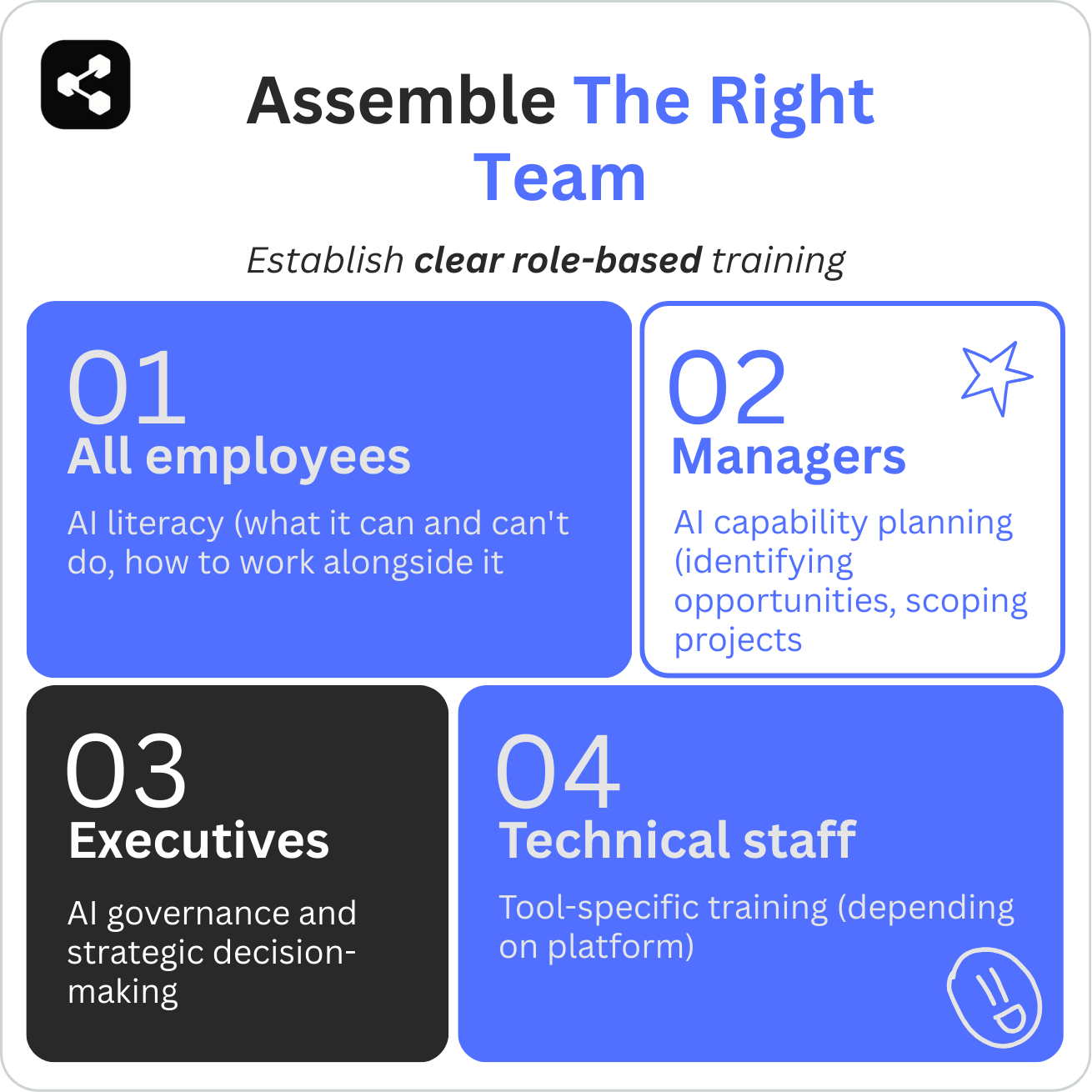
Assemble the right team by establishing clear role-based training:
- All employees: AI literacy training — what AI can/can't do, how to work alongside it
- Managers: AI capability planning — identifying opportunities, scoping projects
- Executives: AI governance and strategic decision-making authority
- Technical staff: Platform-specific training on deployment standards and risk controls
The goal isn't making everyone an AI expert. It's making sure everyone knows enough to collaborate effectively.
3. Select AI Solutions That Match Your Requirements
The tool (step 3) should solve your business problem (step 1) using your existing data infrastructure (step 2).
AI adoption fails when organizations choose tools before defining requirements. Match AI technologies to your specific use cases:
For workflows that are predictable most of the time but break down in edge cases—like customer support, onboarding, or internal approvals—look for AI agent platforms that combine structured flows with LLM reasoning. If you are curious about LLM Agents, read our complete guide.
An agent can follow a predefined process for common requests, but reason through unusual situations instead of failing or escalating immediately.
For predictive analytics: You need ML platforms that can retrain models automatically as patterns shift.
You should look for continuous learning pipelines that update models based on new data without manual intervention, anomaly detection that flags when predictions degrade, and version control for the models (to roll back if retraining makes things worse).
For customer interaction at scale: Conversational AI platforms that integrate with your knowledge bases, CRM, and support tools. Find about the "11 Best Conversational AI Platforms" in 2026 here.
For computer vision and inspection: Domain-specific solutions often outperform general-purpose tools. Engineers built BMW's quality inspection system specifically for automotive defects because generic image recognition wouldn't deliver the same accuracy.
4. Prove Value With Production-Ready Pilots
Deploy with real users, real workflows, and real data — not a controlled lab environment.
Concentrix's research on AI pilots shows that projects with ongoing feedback and human evaluation are more likely to succeed. In contrast, treating pilots as one-time experiments does not allow for good scaling.
Use this three-phase approach to integrate ongoing feedback into your pilot:
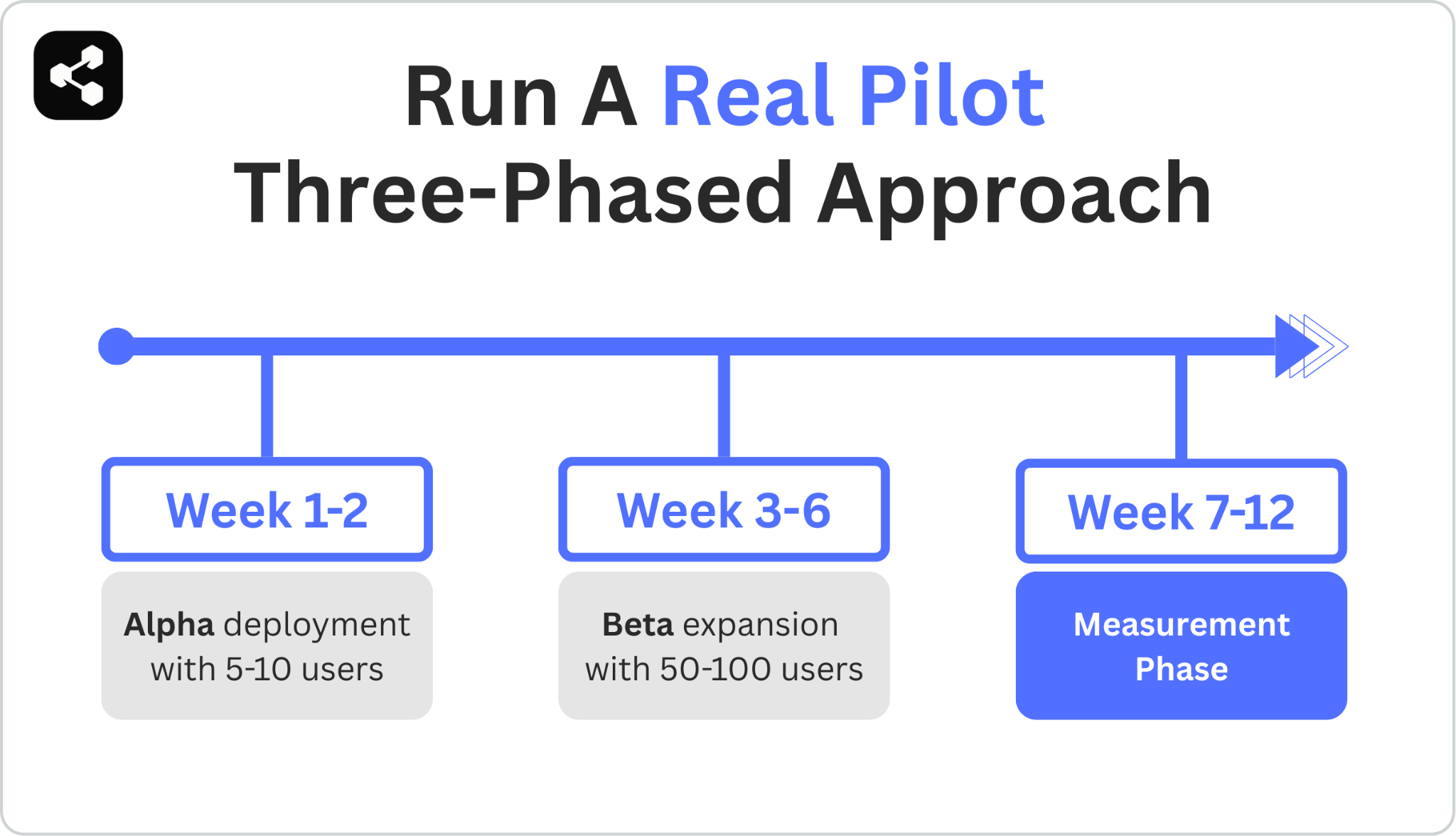
Week 1-2: Alpha deployment with 5-10 users. This is the first stage of your pilot rollout with your friendliest, most forgiving early adopters.
Week 3-6: Beta expansion to 50-100 users. Representative of your eventual user base. Focus on usability and integration. Adjust workflows based on usage patterns weekly.
Week 7-12: Measurement phase. Are you hitting the metric targets you defined in scoping? Adjust every two weeks if you don't align.
Remember: successful pilots account for friction rather than avoiding it—a pattern we explored in “Why Most Digital Transformation Efforts Fail" part of this article.
5. Scale Proven AI Solutions (Horizontal Vs. Vertical)
Now that you've proven the pilot, you can use the same solution for different cases (horizontal scale) or improve it in the same case (vertical scale).
Most organizations try to do both simultaneously and end up doing neither well.
But first, what are horizontal and vertical scaling?
Horizontal scaling: Take the same solution and deploy it across similar use cases (e.g., fraud detection in credit cards can be implemented to fraud detection in wire transfers).
Vertical scaling: Deepen the solution in the same use case (e.g., fraud detection that handles more volume, more edge cases, more transaction types).
How to choose between horizontal and vertical scaling?
- If your pilot project provided a 10x ROI, focus on horizontal expansion first. You can apply it to five or more similar cases with minor adjustments.
- If your pilot delivered moderate ROI but you identified clear paths to 3-5x improvement through refinement, go vertical first. Prove the full value before expanding.
Standardization comes last. Reusable templates, processes, and infrastructure only make sense once you know what truly works at scale.
6. Monitor Performance and Evolve Your AI Portfolio
At Botpress, we've deployed thousands of AI agents across industries. The consistent pattern we see: continuous performance monitoring separates long-term value from gradual failure.
Performance tracking tells you two critical things—what to improve and when to shut down. Review your AI systems quarterly using this framework:
- Review performance against original targets.
If your fraud detection system was designed to catch 95% of suspicious transactions, is it still hitting that benchmark?
- Assess whether targets still matter (business priorities shift).
That 95% fraud accuracy might have been critical when you were losing money to scammers, but if you've implemented other controls, speed might matter more than precision now.
- Identify drift (model performance degrading? Business patterns changing?)
Technical drift happens when your model's accuracy degrades because customer behavior or market conditions changed.
Strategic drift happens when your business moves in a direction that makes this AI less relevant.
- Readjust or retire.
Not every AI project should run indefinitely. Some solve temporary problems—like a chatbot built to handle a product launch spike that's no longer needed once the launch ends. Others get replaced by better approaches—your rule-based fraud system might work, but a machine learning model catches patterns it can't.
Ask: If we were starting from scratch today, would we build this? If not, shut it down.
Three AI in Digital Transformations Examples
Ruby Labs: From 100 Support Agents to 4 Million Automated Sessions
Ruby Labs manages six subscription apps with millions of active users. Traditional customer support couldn't scale.
How AI solved it: Ruby Labs deployed AI agents across their entire app portfolio to handle customer support autonomously.
The agents authenticate users, process subscription changes, issue refunds, and answer technical questions—all without human intervention.
- 98% resolution rate - only 2% of interactions require human escalation
- 4 million chatbot sessions monthly across six apps
- 65% reduction in manual support tickets for their flagship app, Able
- $50,000+ annual cost savings from eliminated support overhead
According to Alexandru Bogdan, Head of Support at Ruby Labs: "After evaluating several AI-powered chatbots, we determined that Botpress best meets the requirements of companies like ours. Instead of spending time training a model from scratch, we can quickly deploy AI capabilities that meet our exact needs."
[Learn more: How Ruby Labs automates 4 million support interactions per month]
Waiver Consulting Group: 25% More Leads Without Adding Sales Staff
Waiver Group helps healthcare providers navigate complex Medicaid Waiver Programs.
During the busy season, their sales team couldn't keep up with inbound inquiries, and traditional contact forms weren't qualifying leads effectively.
How AI solved it: Working with Botpress partner Hanakano Consulting, Waiver Group deployed Waiverlyn—an AI agent that greets website visitors, answers service questions, qualifies leads, and books consultations directly into Google Calendar with video conferencing links and detailed email invites.
- 25% increase in booked consultations
- 9x jump in visitor engagement compared to traditional web forms
- Positive ROI after 3 weeks - Waiverlyn paid for its entire development cost within the first month
"Some of our clients know exactly what they want and want to get started right away," explains Amara Kamara, Licensing & Certification Manager. "Waiverlyn can send them right to our self-serve portal where they can create an account and start uploading their documents."
[Learn more: How Waiver Group's 25% increase in leads delivered full ROI after 3 weeks]
hostifAI: 75% of Hotel Guest Conversations Handled Autonomously
Hotels require 24/7 multilingual support for guest requests ranging from room service to tour bookings to housekeeping needs. Traditional front desk operations create bottlenecks, and email communication has dismal open rates (typically 40% at best).
hostifAI, a Botpress Certified Expert Partner, deploys "Virtual Butler" AI agents across hotel properties.These agents handle guest communications via WhatsApp, Telegram, and Facebook Messenger, coordinating requests across multiple hotel departments automatically.
- 75% of conversations handled without human escalation
- 70% of guests interact before arrival - making reservations and purchases before check-in
- 20% of guests purchase additional services through the chatbot before arriving
Badr Lemkhente, CEO of hostifAI, explains the operational impact: "A guest ordered room service and requested an extra floor towel. The Virtual Butler guided them through meal options and transmitted the towel request to housekeeping. Both needs were handled at once, even though they required two different teams—no waiting for the guest, no multiple calls for the Front Office."
[Learn more: How hostifAI handles 75% of conversations without humans]
Frequently Asked Questions
1. How is AI transformation different from traditional digital transformation?
AI transformation differs from traditional digital transformation in how it handles decision-making. Traditional digital transformation digitizes existing processes (moving them to cloud, workflow software, data platforms), while AI transformation redesigns the decision-making process itself using AI.
2. Why do most AI transformation initiatives fail?
Most AI transformation initiatives fail for three reasons: organizations treat AI as a technology project rather than business transformation, they automate existing processes instead of redesigning workflows, and they invest 70% in technology when they should invest 70% in people and processes.
3. Do we need a data scientist to implement AI transformation?
No—to implement ai transformation, you need domain expertise and clear business problems before you need data scientists. Data scientists become critical when scaling from pilots to production, but the 10-20-70 rule applies: 70% people and processes, 20% tech/data, 10% algorithms.
4. What industries see the biggest ROI from AI transformation?
Financial services sees the biggest ROI from AI transformation, particularly in fraud prevention and credit decisioning. Retail, manufacturing, healthcare , and logistics, follow closely—but execution matters more than industry.
5. How do we prioritize AI use cases?
Use a three-axis framework to prioritize AI use cases: (1) Business impact—measurable outcome if successful, (2) Technical feasibility—data and capabilities available, (3) Organizational readiness—will people actually use it? Prioritize cases scoring high on at least two of three. Avoid low-readiness projects even if impact is high.
6. Should we build custom AI models or use pre-trained ones?
Start with pre-trained models and fine-tune for your domain. Custom models require massive data, compute, and expertise — only justified when competitive advantage demands it. Vertical AI models (domain-specific pre-trained) often outperform both generic models and custom builds for specialized use cases.
7. Why AI governance is critical to successful AI transformation?
Governance enables speed when done right. The NIST AI RMF provides a framework: Govern (policies), Map (identify risks), Measure (assess), Manage (respond). EU AI Act penalties reach €35 million or 7% of revenue — making governance non-optional by August 2026.