


- Botpress stood out for AI-to-human handoff flexibility and usage-based pricing
- The right platform depends on team size, channel coverage, and whether the goal is full automation or agent assistance
- Options range from no-code tools for lean support teams to enterprise platforms managing voice, chat, and messaging across 35+ channels
- Each entry covers key features, pros, cons, and pricing to surface the right fit faster
AI will resolve 80% of customer service issues by 2029. That timeline looked ambitious two years ago. But now, with AI agents handling ticket deflection, live handoff, and full-resolution workflows autonomously, it looks conservative.
The AI customer service software market is growing at a 25.8% CAGR, — a signal that the era of chatbots is giving way to AI agents.
I tested the most popular AI agents for customer service and compiled a list of the top platforms to help you run your customer support operations.
This list reflects a painstakingly long testing process (yes, I care about you guys that much) across all the platforms mentioned here. I measured each platform against the same criteria and cross-referenced results with G2 reviews and official product documentation.
I used the following criteria to evaluate each AI agent platform:
- G2 rating + review recency: User-validated performance patterns anchor every platform evaluation
- LLM flexibility: Single-vendor lock-in scored lower than multi-model support
- Automation depth: Genuine multi-step resolution outweighs basic ticket deflection
- Pricing transparency: Teams need to forecast costs before committing to a platform
- Integration ecosystem: CRM, help desk, and messaging channel compatibility matter most
- Time to production: Non-technical teams should reach production in days, not months
- Enterprise readiness: I evaluated SOC 2, GDPR, HIPAA, and SLA availability
Not every platform fits every team. The options below range from no-code automation tools for small support teams to enterprise platforms that manage voice, chat, and messaging across dozens of channels. Each one supports a different kind of AI agent.
The right choice depends on existing infrastructure, budget model, deployment timeline, channel coverage, and whether the goal is agent assistance or full autonomous resolution.
1. Botpress
Botpress is the most flexible AI customer support platform on the market for SMBs and mid-market teams.
The platform works as an AI-native support layer that either replaces legacy help desk systems entirely or sits on top of them. AI agents handle ticket classification, troubleshooting, and full-resolution workflows autonomously across chat, email, and messaging channels.
When a conversation needs a human, Botpress hands off to a live agent with full context — and the AI can step back in when the agent is done. That back-and-forth handoff between AI and human runs without friction, which is rare at this price point.
I built a customer support agent on Botpress in under a day. The visual Studio made it easy to map out conversation flows, connect knowledge bases, and test autonomous resolution paths before going live.
Conversation summaries meant agents picking up handoffs didn't need to re-read full threads.
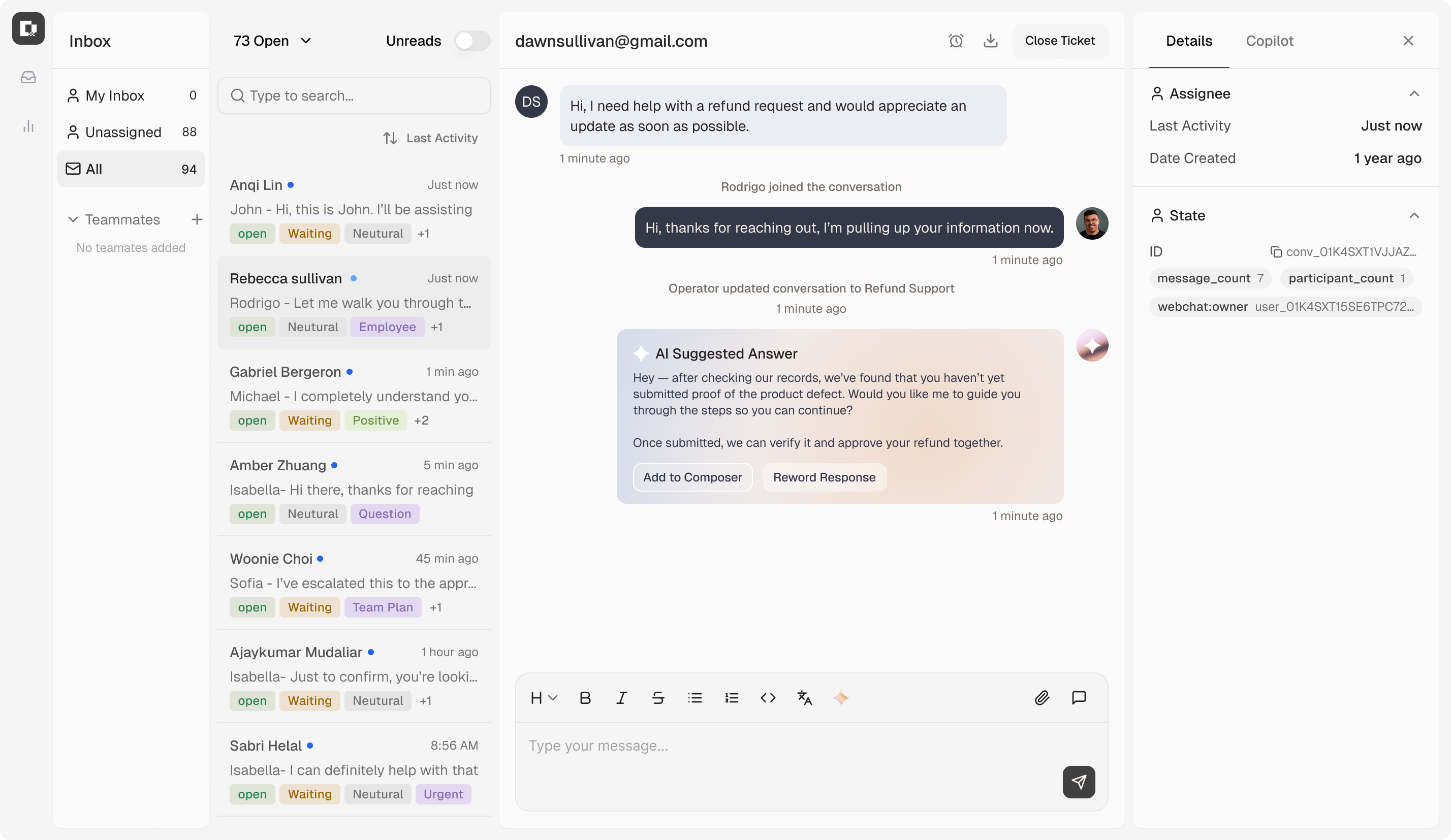
The unified inbox gave me one place to monitor AI-handled and human-handled conversations side by side. I could see which tickets the AI resolved autonomously, which got escalated, and how quickly agents cleared the queue.
LLM costs pass through at provider rates with no markup, and the free tier gave me enough room to validate the full setup before committing to a paid plan.
⭐ G2: 4.5/5 | Capterra: 4.5/5
Botpress Key Features
- AI ticket classification across intent, urgency, and sentiment
- Fluid back-and-forth AI-human handoff
- Unified inbox for AI and agent conversations
- Autonomous technical troubleshooting workflows
- Conversation summaries for instant agent context
Botpress Pros
- Free tier with enough depth to validate production use cases
- LLM costs pass through at provider rates with zero markup
- Works standalone or as an AI layer on legacy systems
- AI ticket routing replaces manual sorting
Botpress Cons
- Steep learning curve for teams without technical resources
- Documentation gaps slow down advanced configuration
- AI spend becomes hard to forecast at high conversation volumes
Botpress Pricing
2. Ada
Ada is an AI-powered customer support platform targeting enterprise teams that want to automate high-volume interactions without spending hours writing code.
Ada's Reasoning Engine connects to CRMs, billing platforms, and commerce tools to resolve multi-step issues across chat, email, voice, SMS, and social channels.
Ada functions less like a chatbot and more like an employee who never sleeps, never escalates a password reset, and can speak 50+ languages.
The no-code builder lets support teams design AI conversation flows with drag-and-drop.
SOP-driven playbooks structure how the AI thinks through resolutions, and native integrations with Salesforce, Zendesk, and Shopify mean less time wiring things together and more time watching tickets actually get resolved.
⭐ G2: 4.6/5
Ada Key Features
- SOP-driven playbooks for structured AI resolution
- No-code drag-and-drop conversation builder
- Native Salesforce, Zendesk, and Shopify integrations
Ada Pros
- No-code builder lets non-technical teams launch without developers
Ada Cons
- Opaque pricing with no public rate card
- Reporting inconsistencies make it hard to measure bot effectiveness
Ada Pricing
3. Intercom (Fin)
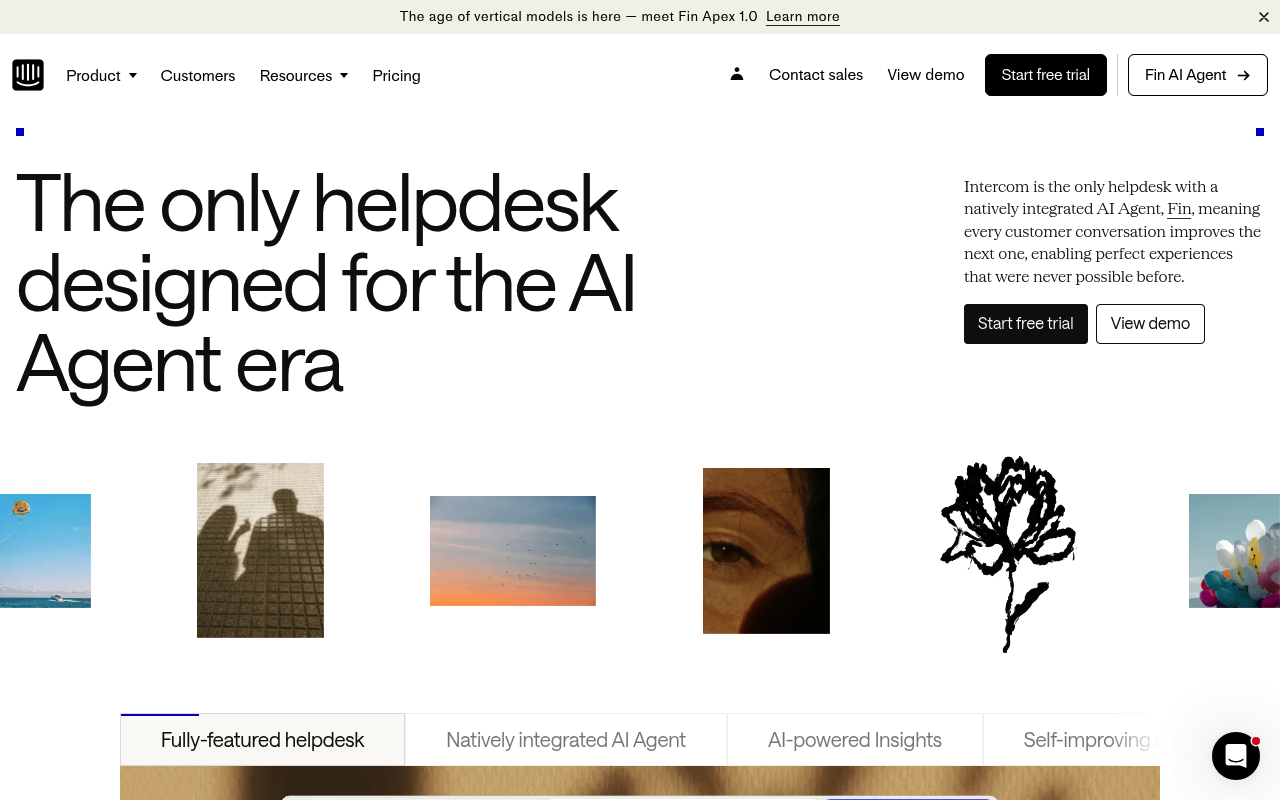
Intercom is a customer messaging platform used by support, sales, and product teams to communicate with customers through live chat, email, and in-app messaging.
Fin is Intercom's AI customer service agent, built to resolve complex support conversations end-to-end across chat, email, voice, SMS, and social.
It runs on a proprietary model trained for customer service. Through Data Connectors, it can also pull real-time CRM, billing, and order data.
Fin executes multi-step workflows like refund processing, account updates, and troubleshooting autonomously, then hands off to human agents with full conversation context when needed.
⭐ G2: 4.5/5 | Capterra: 4.5/5
Fin Key Features
- Proprietary AI model trained for customer service
- Data Connectors for real-time CRM and billing
- Autonomous refund, account update, and troubleshooting workflows
Fin Pros
- Strong multi-step resolution across chat, email, and voice
Fin Cons
- Per-resolution pricing becomes unpredictable during volume spikes
- Tightly coupled to Intercom's ecosystem, limiting multi-platform flexibility
Fin Pricing
4. Zendesk
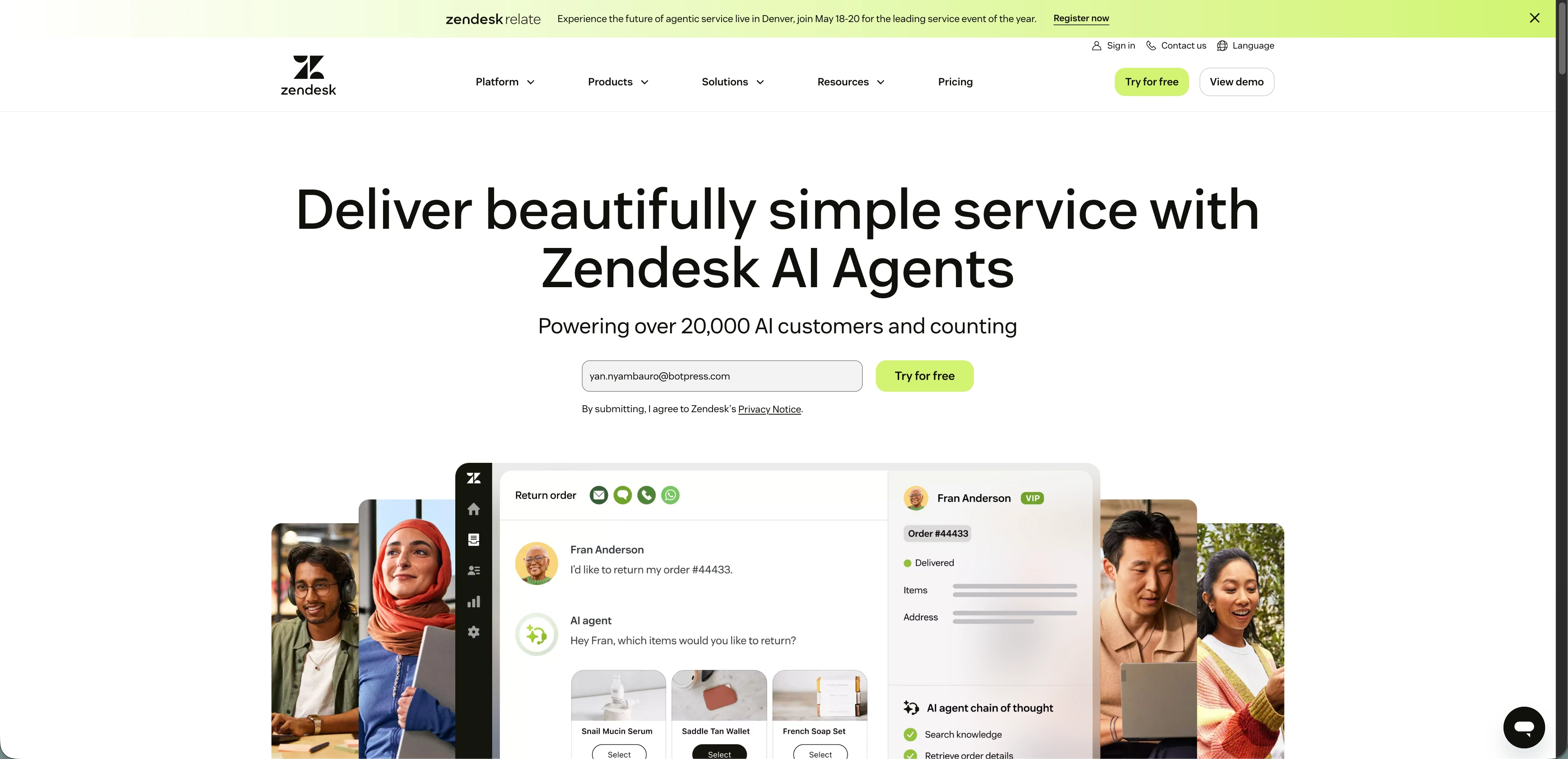
Zendesk is an enterprise customer service platform used by support teams to manage tickets, live chat, and help center content across channels.
The platform covers email, chat, messaging, and voice, and offers a marketplace of 1,200+ third-party integrations.
Teams already on Zendesk don't need to rip anything out. Zendesk AI layers directly on top of existing workflows: auto-classifying tickets by intent, routing them to the right agent, and deflecting routine questions before they hit the queue.
AI Copilot is a separate paid add-on that gives agents more hands-on assistance.
It sits inside the agent workspace during live conversations, drafting reply suggestions, summarizing long ticket threads, and surfacing relevant knowledge base articles in real time.
Zendesk AI handles automation behind the scenes, while Copilot whispers in the agent's ear during live conversations.
⭐ G2: 4.3/5 | Capterra: 4.4/5
Zendesk Key Features
- Auto-classification of tickets by intent and language
- AI Copilot with reply drafts and thread summaries
- 1,200+ third-party integrations via marketplace
Zendesk Pros
- Teams already on Zendesk add AI without switching platforms
Zendesk Cons
- AI Copilot must be purchased for all agents
- Fragmented interface forces agents to navigate multiple tabs
Zendesk Pricing
5. Tidio
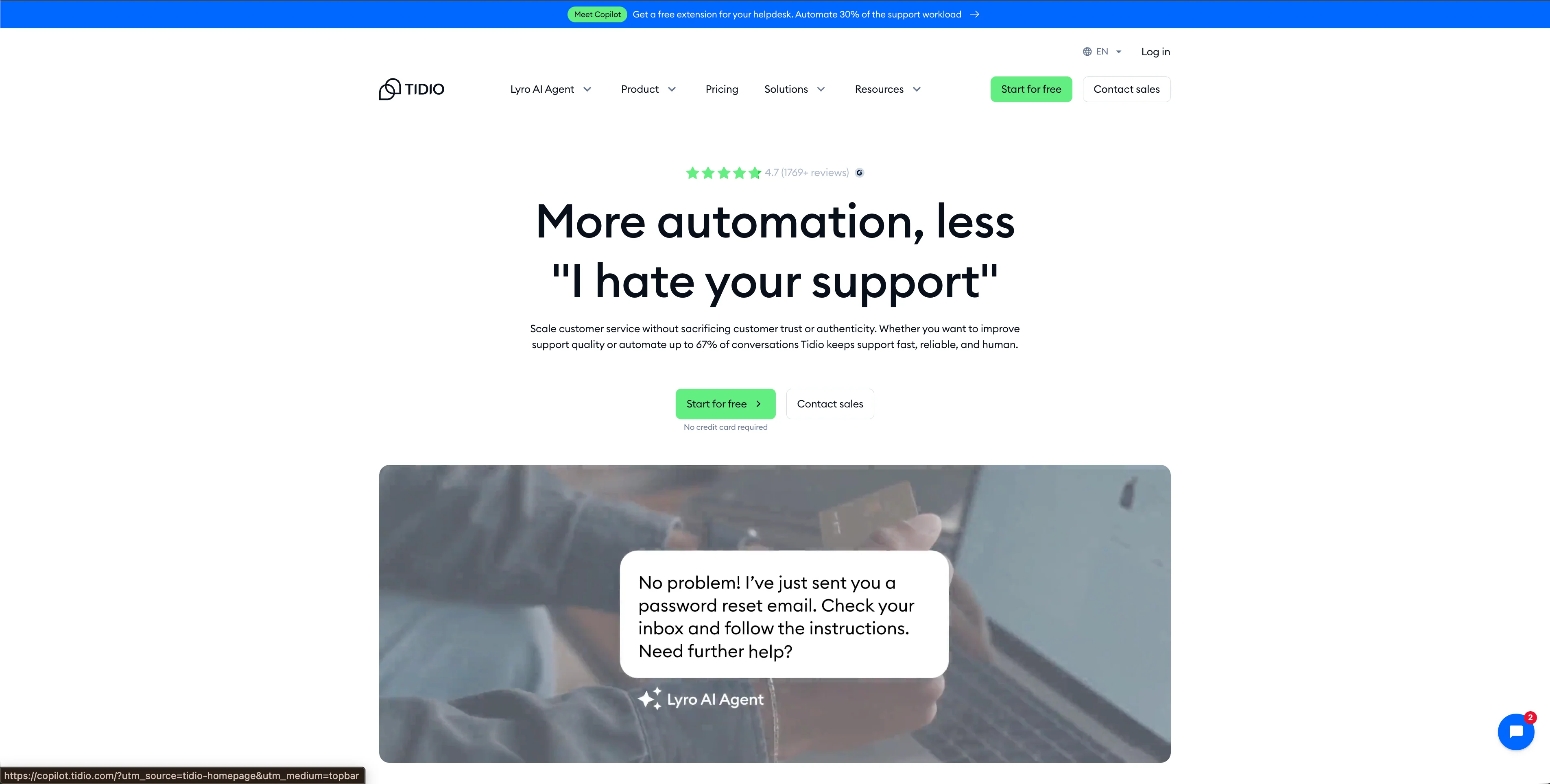
Tidio is a customer service platform built for small and mid-sized businesses that need live chat, chatbot automation, and AI-powered support in one package without enterprise complexity.
Lyro is Tidio's AI agent. It handles repetitive customer questions using natural language, trained on help center content and FAQ data, and hands off to a human agent with context intact when it can't resolve an issue.
The platform supports chat, email, Instagram, Messenger, and WhatsApp from a single inbox, with a visual drag-and-drop Flows builder for creating custom automations and conversation paths without code.
Lyro runs on Anthropic’s Claude model, and every Tidio account starts with 50 free AI conversations for testing.
⭐ G2: 4.7/5 | Capterra: 4.8/5
Tidio Key Features
- Lyro AI agent trained on help center content
- Visual drag-and-drop Flows builder for custom automations
- Single inbox across chat, email, and social channels
Tidio Pros
- Signup-to-live deployment takes hours
Tidio Cons
- Conversation caps and AI limits restrict growth quickly
- Lyro handles FAQ deflection, not complex multi-step resolution
Tidio Pricing
6. Salesforce’s Agentforce
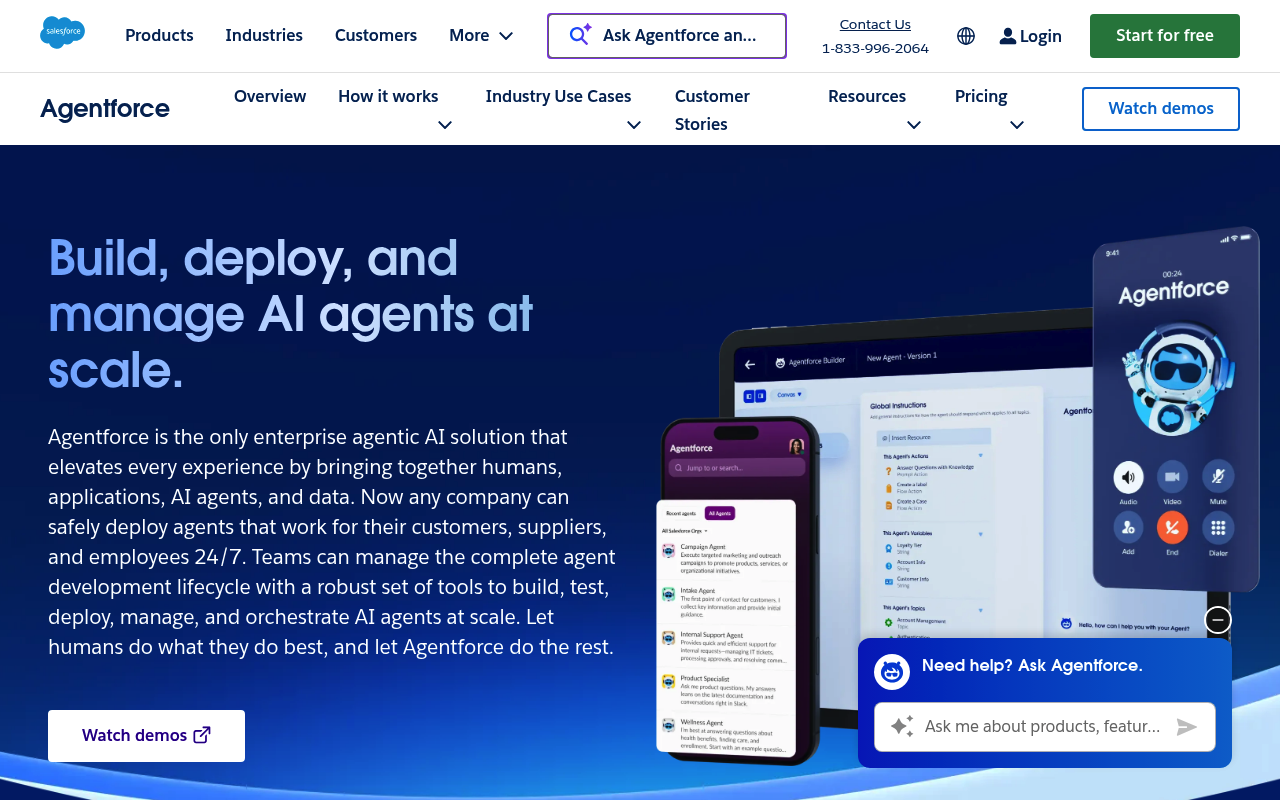
Salesforce is a global enterprise CRM used to manage sales pipelines, service operations, and customer data across industries.
Agentforce is Salesforce's AI agent platform for Service Cloud. It automates customer interactions by embedding AI agents directly into CRM workflows — agents access customer records, execute multi-step actions like refunds, case updates, and appointment scheduling, and operate across email, chat, voice, and portals.
The Atlas Reasoning Engine handles autonomous decision-making for complex queries, while native Salesforce CRM and Data Cloud integration gives agents full customer context without connectors or imports.
Service teams can create agents through a low-code agent builder using natural language descriptions instead of programming.
⭐ G2: 4.3/5 | Capterra: 4.4/5
Agentforce Key Features
- Atlas Reasoning Engine for autonomous decision-making
- Low-code Agent Builder using natural language descriptions
- Native Data Cloud integration for full customer context
Agentforce Pros
- AI agents access the full CRM customer context by default
Agentforce Cons
- Three simultaneous pricing models create budgeting complexity
- Implementation often requires paid consultants at $2,000–$6,000+ per agent
Agentforce Pricing
7. Freshdesk
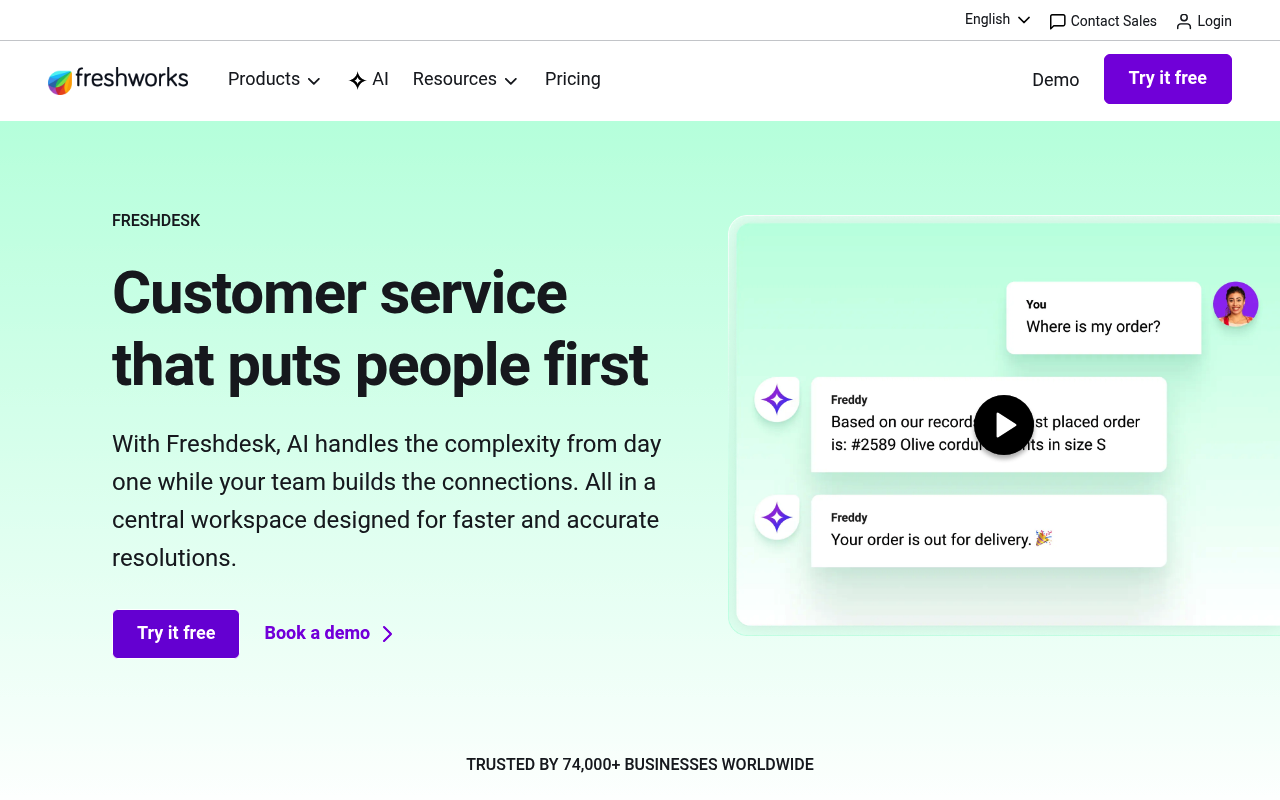
Freshdesk is a cloud-based help desk platform by Freshworks designed for small and mid-sized support teams that need multichannel ticketing, automation, and AI assistance.
Email, chat, phone, and social channels all flow into one workspace with 1,000+ integrations.
The AI side splits into two tools. Freddy AI faces the customer, handling routine questions and classifying, tagging, and routing tickets before an agent ever sees them.
Freddy Copilot faces the agent: it sits inside live conversations, drafting replies, summarizing long threads, and pulling up knowledge base articles so agents aren't hunting for answers mid-chat.
⭐ G2: 4.4/5 | Capterra: 4.5/5
Freshdesk Key Features
- Freddy AI chatbot for autonomous ticket resolution
- Freddy Copilot with reply drafts and KB surfacing
- 1,000+ integrations, including Slack, Shopify, and Salesforce
Freshdesk Pros
- Beginner-friendly interface with fast onboarding
Freshdesk Cons
- Steep learning curve for advanced automation
- Agent-assist features are locked behind paid upgrades
Freshdesk Pricing
8. Gorgias
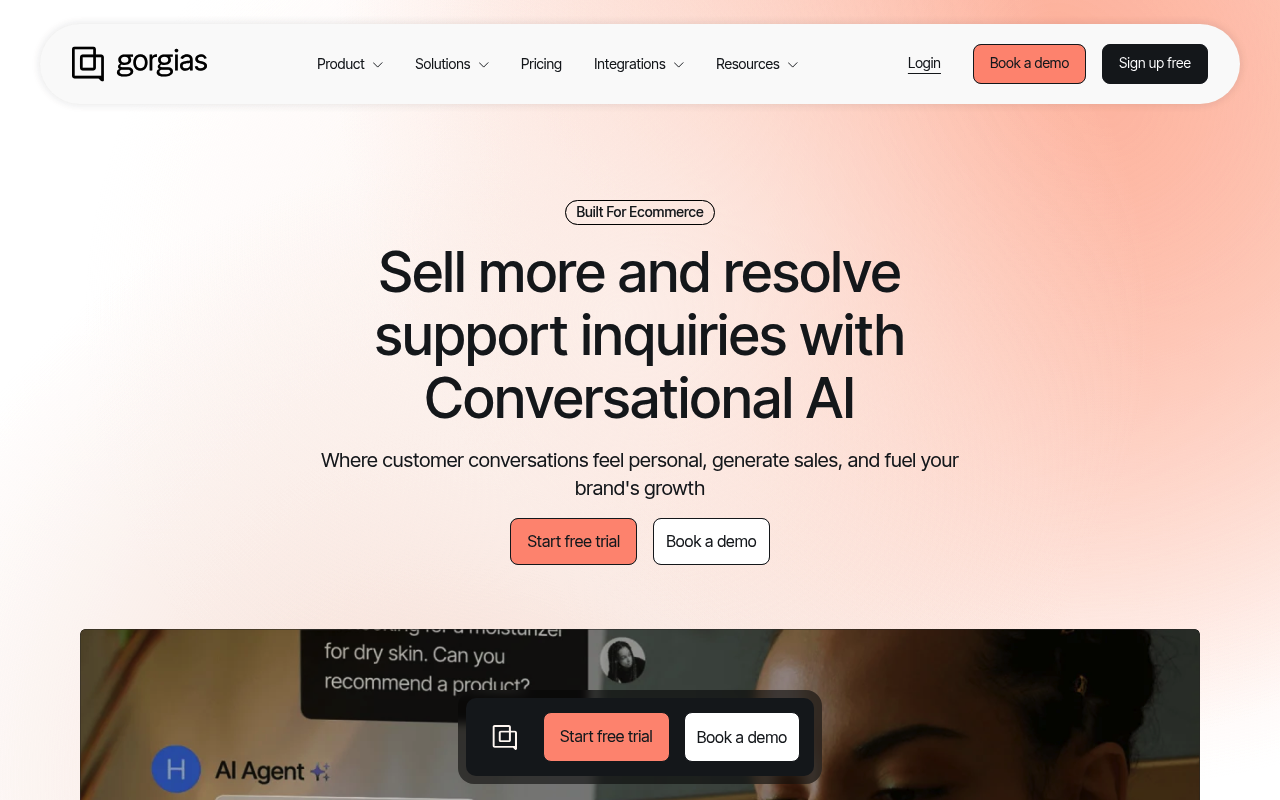
Gorgias is an e-commerce help desk designed for online retailers that need deep storefront integration and revenue-driven customer support.
The platform connects natively to Shopify, Magento, and WooCommerce, pulling in real-time order data, customer history, and product catalogs so agents can process refunds, edit orders, and resolve inquiries without leaving the inbox.
Gorgias's AI Agent autonomously handles common support queries like order tracking and returns, while revenue attribution links tickets directly to sales. All channels (email, chat, SMS, and social DMs) flow into a unified multichannel workspace.
⭐ G2: 4.6/5 | Capterra: 4.7/5
Gorgias Key Features
- Native Shopify, Magento, and WooCommerce storefront integration
- AI Agent for autonomous order tracking and returns
- Revenue attribution linking tickets directly to sales
Gorgias Pros
- Ties support interactions directly to revenue attribution
Gorgias Cons
- Ticket-based pricing becomes unpredictable during peak sales periods
- Limited to e-commerce use cases
Gorgias Pricing
9. Kore.ai
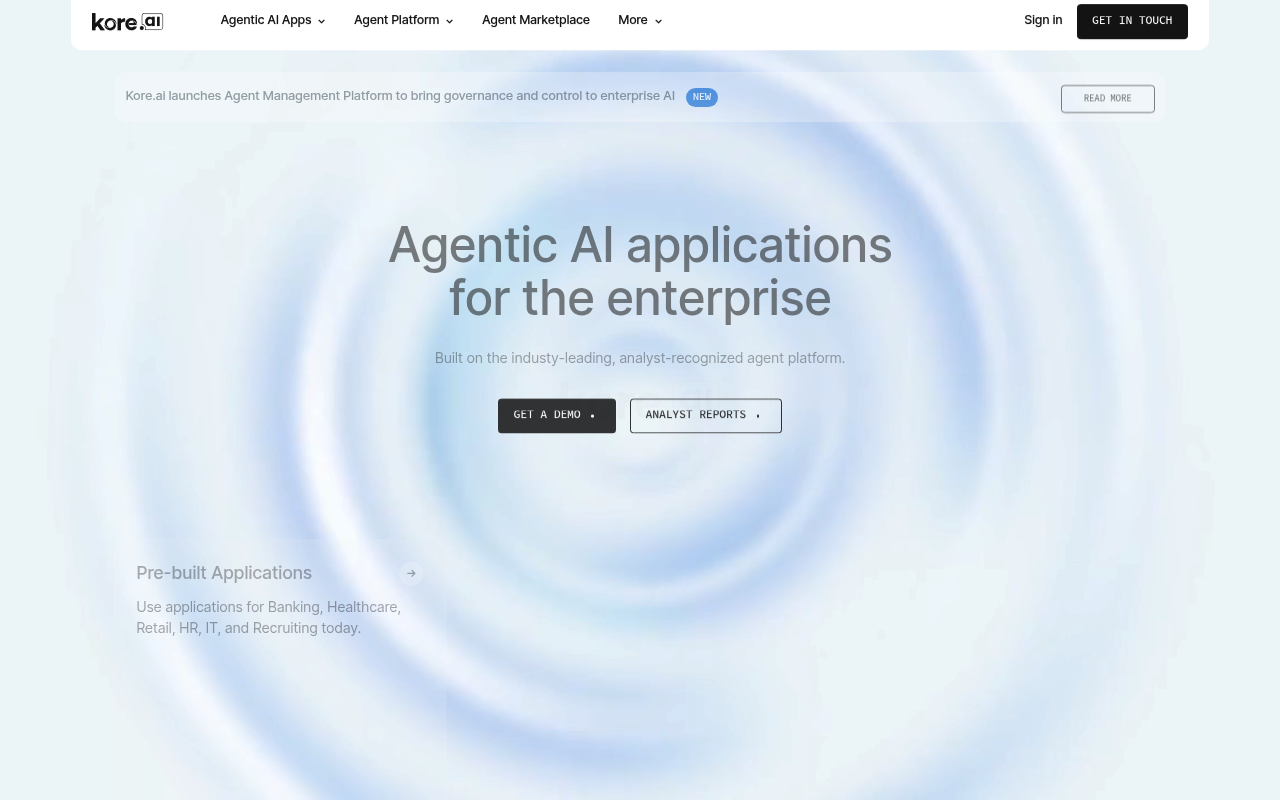
Kore.ai is a conversational AI platform designed for large enterprises that need to automate customer service across voice and digital channels — particularly contact center operations.
Teams build virtual assistants on the XO Platform using a no-code/low-code dialog builder, train them with multi-engine NLU for intent recognition, and deploy across the full channel stack without rebuilding for each one.
Multi-step workflows handle account management, appointment booking, troubleshooting, and live data pulls from CRM, ERP, and help desk integrations. If the organization operates in banking, healthcare, or telecom, enterprise governance and compliance controls are also built in.
⭐ G2: 4.4/5 | Capterra: 4.5/5
Kore.ai Key Features
- Multi-engine NLU for intent recognition across languages
- No-code/low-code dialog builder for virtual assistants
- Enterprise governance and compliance controls built in
Kore.ai Pros
- 35+ voice and digital channels deployed from one platform
Kore.ai Cons
- Implementation timelines of 6–18 months for complex deployments
- Documentation is hard to navigate and poorly organized
- Version updates are poorly communicated to users
Kore.ai Pricing
10. Drift
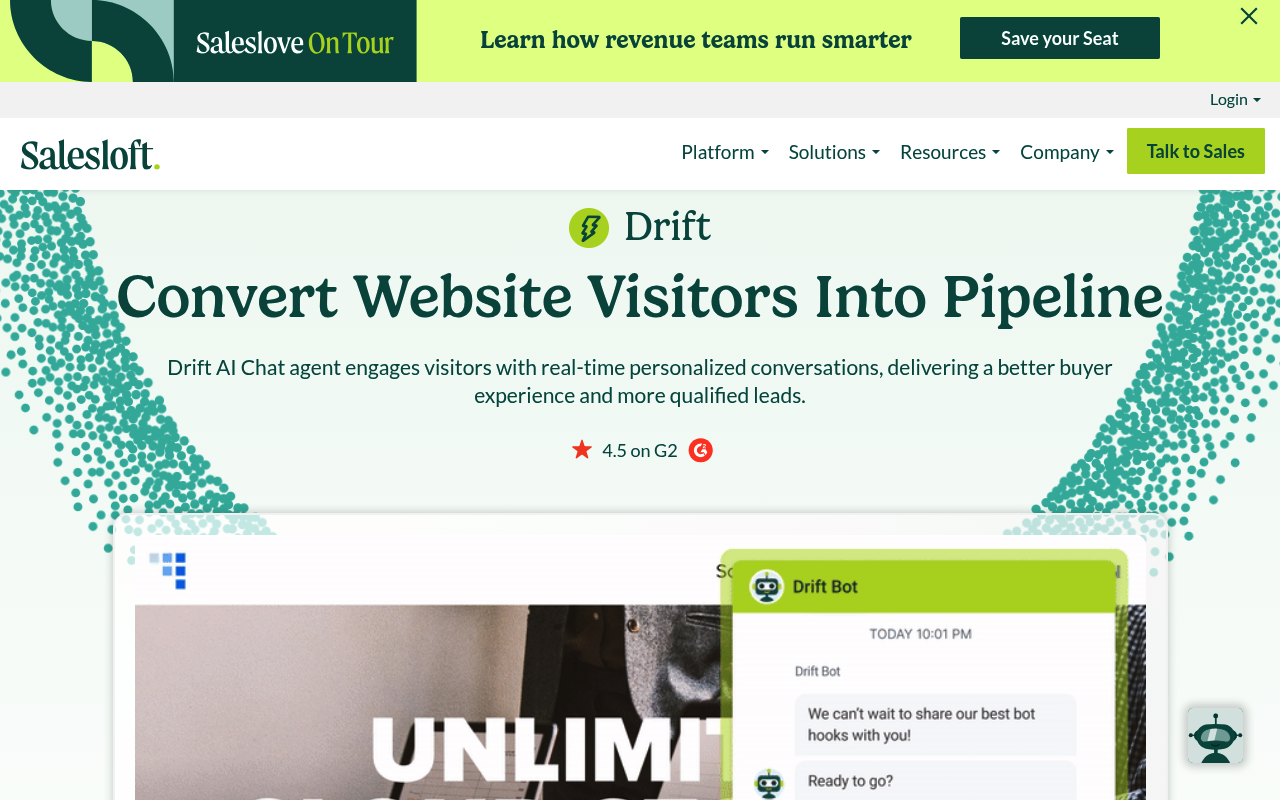
Drift is a conversational AI platform built for B2B sales and marketing teams. Drift has shifted from a standalone chat tool to a module within a broader revenue platform.
Drift's chatbots use playbook-based logic to qualify website visitors, route high-intent prospects to reps, and book meetings autonomously.
GPT integration lets the AI hold natural conversations that go beyond scripted flows, and Fastlane routes VIP accounts to live reps the moment they land on a page.
On the support side, Drift handles basic customer inquiries through the same chatbot framework. But the routing logic was designed for sales qualification, not multi-step support resolution. Complex tickets still require a dedicated help desk.
⭐ G2: 4.4/5 | Capterra: 4.5/5
Drift Key Features
- Playbook-based chatbots with GPT integration
- Fastlane routing for high-intent account engagement
- Native Salesforce and HubSpot CRM integration
Drift Pros
- Mature chatbot builder with natural AI conversation quality
- Strong Salesforce integration for B2B pipeline visibility
- Combines lead qualification and basic support in one tool
Drift Cons
- $2,500/month minimum prices out most SMBs
- Sales-first design limits depth for pure support use cases
- Salesloft acquisition creates roadmap uncertainty for support features
- No free tier or trial for pre-purchase validation
Drift Pricing